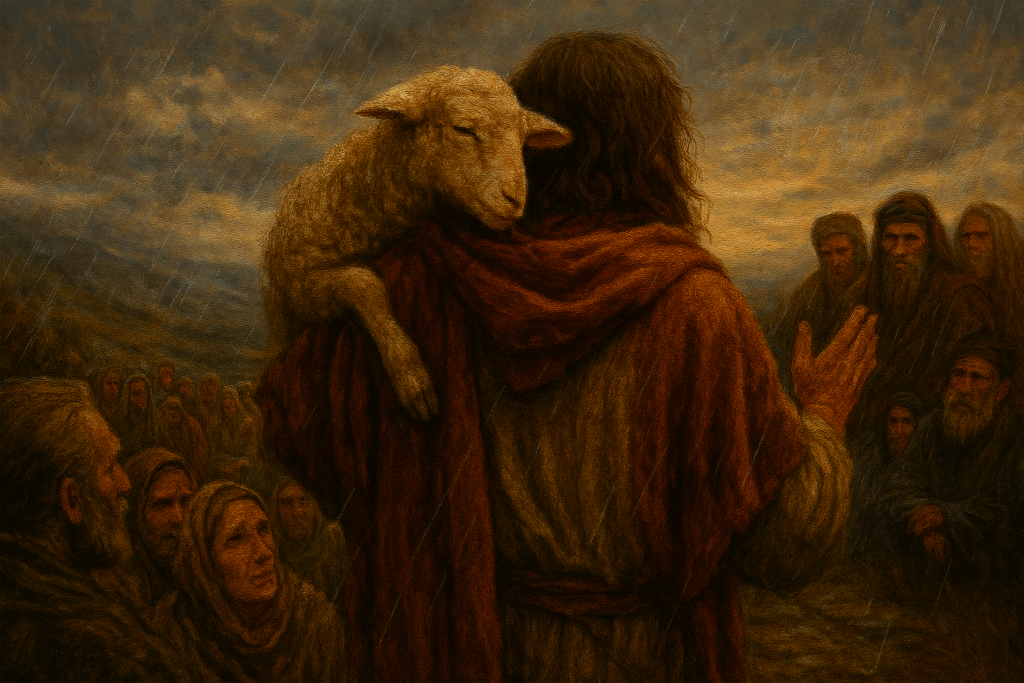


To learn more about this subject, you can consult the pericope PER243 : The parable of the lost and found sheep, as well as the study PAR031 : The lost and found sheep.
We are in the house at Capernaum where the Messiah Jesus continues to teach his apostles, disciples, and their families who are present. The various themes addressed are reported by Matthew and Peter, co-author of the second Gospel with Mark, who were present. In this particular case, Mark does not cite this but Luke takes it up. The room seems large enough to accommodate all the people present. This meeting took place before 3 October AD 32, the date on which the group leaves Galilee for good. It is not specified whether these teachings took place during a single meeting or over several gatherings.
We observe a strong cohesion around the Master as well as a gradual isolation of the group. The announcement of his death has evidently caused disturbance among his close ones, thus creating an increased need to gather. The Messiah Jesus is aware that in a few days he will depart with his apostles and will probably not see most of his loved ones again. He therefore strives to pass on to them as much teaching as possible in order to prepare them for his absence.
Regarding the subject of the 100 sheep, it is worth noting that the divine satisfaction when a wandering soul is converted constitutes a of encouragement for the whole group.
The passages of Matthew 18.10-14 and Luke 15.3-7 present a similar : that of the lost sheep. In Matthew, the Messiah Jesus insists on the value of the ‘little ones’ and on the heavenly Father’s will not to lose any of them. He puts forward the idea that God actively seeks those who go astray and rejoices at their return. Luke, for his part, develops further the joy of the shepherd when he finds the lost sheep, underlining the heavenly celebration over a sinner who repents.
The main difference lies in the orientation of the message: Matthew integrates it into a discourse on humility and concern for the weakest, whereas Luke places it in a series of parables on divine mercy and repentance.
The choice of the sheep in this is not fortuitous, since it is devoid of means of defense and is easy prey for predators. This underlines its need for protection by the shepherd (John 10.11, John 10.14 and Ezekiel 34.23).
The of the sheep in Matthew 18.10-14 highlights the idea that God does not want to lose any of his ‘little ones’ and that he actively seeks those who go astray. This image of the shepherd watching over his sheep can be related to the mission of the Messiah Jesus, who presents himself as the good shepherd in John 10.11-18.
In the context of the Master’s imminent death, this takes on an even deeper dimension: the Messiah Jesus, as shepherd, knows that he will have to leave his disciples physically, but he assures them that they will not be abandoned. He prepares his disciples for this separation by promising them the Holy Spirit as guide and comforter (John 14.16-18).
Thus, the of the lost sheep can be seen as a prefiguration of the Messiah Jesus’ solicitude for his disciples after his departure. He does not leave them alone, but continues to seek them and guide them spiritually, like a shepherd watching over his flock.