

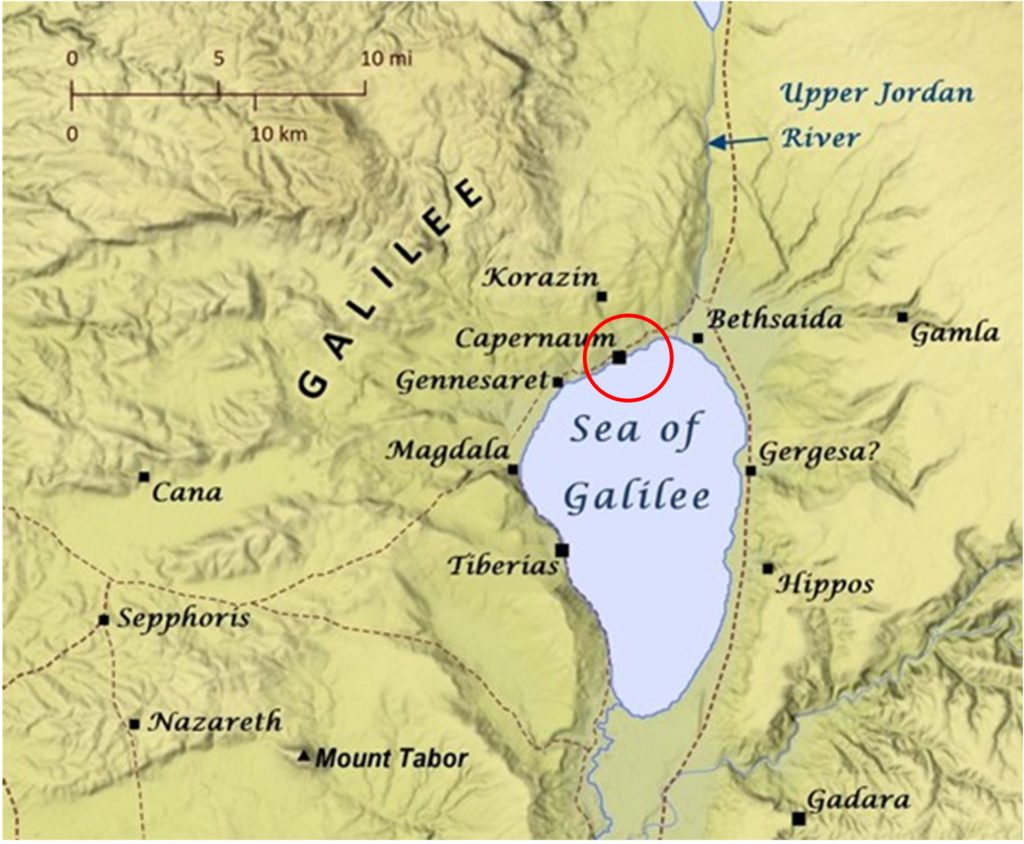
Mark 9.33 does confirm that the group returned to Capernaum, as Matthew states, but it does not mention the story of this tax.
Matthew probably records this event to show his Jewish readers that the Messiah Jesus, although the Son of God, submits to the requirements of the law.
Matthew 17.24-27 relates the episode in which the Messiah Jesus and his disciples arrive at Capernaum, and Peter is asked by the collectors of the Temple tax about the payment of the didrachma. In an instructive exchange with Peter, the Messiah Jesus points out that the sons of kings are exempt from taxes, yet he chooses to pay in order to avoid any offense. He tells Peter to catch a fish, in whose mouth he will find a coin sufficient to pay the tax for the two of them. This may indicate that the other disciples were absent or had already paid this tax. The fact that the collectors addressed Peter suggests that he was alone with the Master and that the other disciples were indeed absent.
This passage highlights several elements:
- The fiscal and religious context: The didrachma was an annual tax intended for the upkeep of the Temple, based on Exodus 30.11-16 (see Nehemiah 10.32). It was collected by commissioners sent throughout the land of Israel.
- The theological teaching: The Messiah Jesus implicitly asserts his divine sonship by pointing out that the sons of kings are not subject to taxes. He thus shows that he is not obliged to pay this tax, but chooses to do so out of concern for social harmony.
- The miracle and its significance: The fact that the coin is found in the mouth of a fish underscores God’s sovereignty over creation and his providence. This miracle also illustrates Jesus’ ability to provide for the material needs of his disciples.
This passage is therefore rich in theological and practical implications, highlighting Jesus’ wisdom in handling social and religious obligations while affirming his divine identity.