
Following the intervention of this woman suffering from bleeding and her healing, the situation unfortunately worsened, leading to the death of the sick girl. Jairus might have thought that his daughter would still be alive without this intervention, just as Mary regretted that Jesus had not arrived sooner to save Lazarus (John 11.21).
The flute players for the funeral were already present, which shows that the death of this girl had been anticipated. We also observe an initiative on the part of Jairus, who chooses to go beyond the restrictions imposed by his position in order to seek the intervention of Jesus the Messiah.
Context
Jairus, a ruler of the , comes to Jesus the Messiah and throws himself at his feet, begging him to come and heal his only daughter, about twelve years old, who is at the point of death.
The story
While Jesus the Messiah is on his way to Jairus' house, a crowd follows and surrounds him. A woman suffering from bleeding touches him and is healed, which causes a delay in the progress toward Jairus' house. Meanwhile, messengers arrive and inform Jairus that his daughter is already dead, and that the Teacher should no longer be troubled.
The Miracle
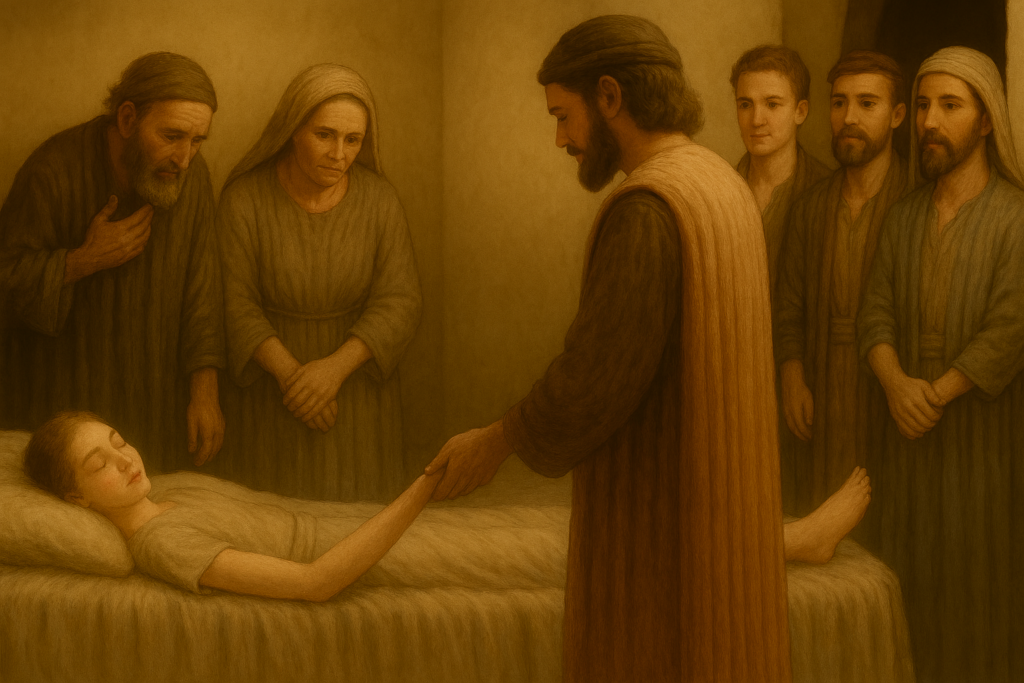
Jesus the Messiah, hearing this, tells Jairus not to fear but to believe (John 11.40). He continues on to Jairus' house, takes with him Peter, James, and John, along with the child's parents, and enters the room where the girl lies.
Jesus the Messiah takes the girl's hand and says: "Talitha koumi", which means "Little girl, arise". Immediately, the girl rises and begins to walk, causing amazement among all who are present.
Meaning
This miracle shows the power of Jesus the Messiah over death, his compassion, and his ability to restore life. It encourages faith in him and underlines the importance of believing even in the face of desperate situations.
It is a magnificent illustration of the authority of Jesus the Messiah and of the hope he offers.
It is important to point out that Jairus, a prominent religious leader, stands out by his unusual act of prostrating himself before Jesus the Messiah, despite the potential criticism of his colleagues, the and . Although one may imagine that he could afterward have organized a feast in honor of Jesus the Messiah, none of the Gospels of Matthew, Mark or Luke mentions such an event.
Differences between the three accounts:
Matthew 9.18-26
Summary: Matthew offers a more concise version of the event.
Interruption: He does not include the story of the healing of the woman with the hemorrhage as fully as Mark and Luke.
Details: The account does not say that the girl was dead at the beginning, but rather that she is already dead when Jairus comes to Jesus the Messiah.
Touching the hand: Jesus the Messiah touches the girl's hand to raise her, although the law forbade touching a corpse (Leviticus 5.2).
Mark 5.21-43
Details: Mark, contrary to his habit, gives the longest and most detailed account.
Interruption: He includes the healing of the woman with the hemorrhage in detail, interrupting the story of Jairus.
Emotions: Mark describes the emotions of the characters, including the fear and faith of Jairus and the reaction of those present.
Order of events: The account follows a precise chronological order, showing Jesus arriving at Jairus' house after the healing of the woman.
Luke 8.40-56
Details: Luke offers an intermediate version in terms of length and detail.
Interruption: Like Mark, he includes the story of the woman with the hemorrhage.
Reactions: Luke emphasizes the reactions of the witnesses, especially the crowd and the girl's parents.
Instructions of Jesus the Messiah: Luke explicitly mentions that Jesus the Messiah asks the parents not to tell what had happened. It is clear that the Master gave priority to the proclamation of salvation and access to the kingdom of heaven, rather than emphasizing healing.
Each evangelist brings a unique perspective that enriches our understanding of the event.