
According to Matthew 13.31, this is a , although it is very short. The mustard seed, known today as mustard, is both a seed and a condiment.
We are analyzing the logic of the Gospel according to Matthew, which illustrates the kingdom of God through the of the seed (Matthew 13.1-23). The Gospel then addresses the complexity of the coexistence of good and bad seed (Matthew 13.24-30) and develops the unexpected implications arising from the growth of this seed (Matthew 13.31-35).
Interpretation and main lessons
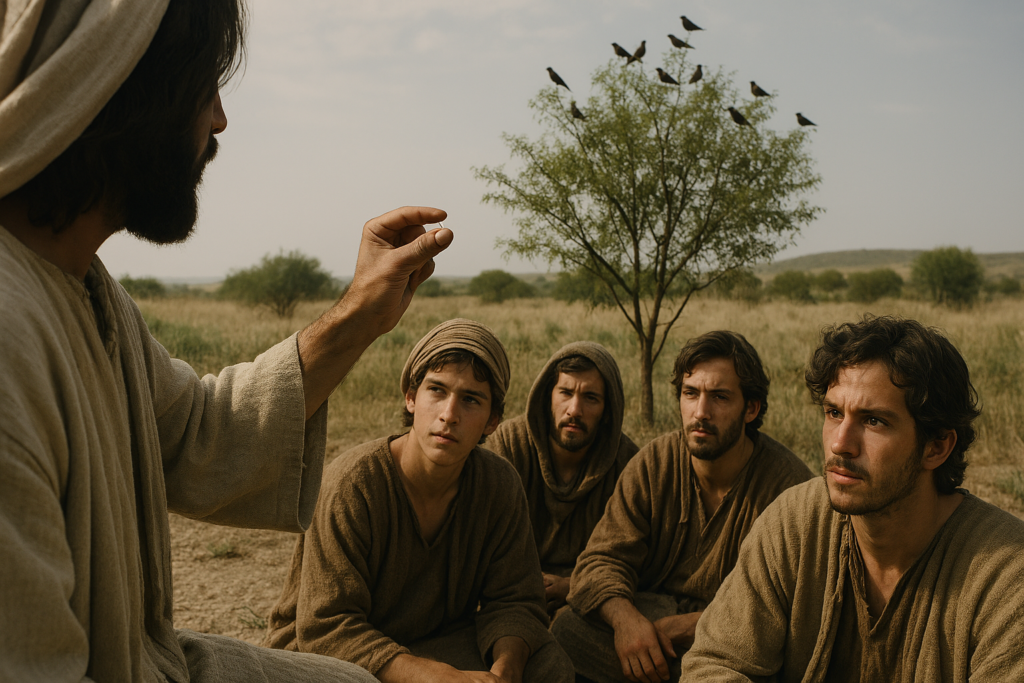
Small beginnings: The mustard seed is described as the smallest of all seeds. This symbolizes the humble beginnings of the kingdom of God. Jesus and his disciples were a small group in a remote corner of the Empire.
Exponential growth: Despite its small initial size, the mustard seed grows into a large tree. This represents the extraordinary growth of the kingdom of God, which starts small but develops to influence the whole world.
Welcome and refuge: The tree that grows from the mustard seed becomes a place where the birds of the air come to live in its branches. This symbolizes the way the kingdom of God offers refuge and welcome to all who come to it.
Faith and potential: The also shows that even faith as small as a mustard seed can grow and produce extraordinary results. It emphasizes the importance of starting with what one has and trusting God for growth.
Mark's and Luke's versions
Mark's and Luke's versions enrich the of the mustard seed by highlighting complementary nuances. Mark 4.30-32 emphasizes the striking contrast between the seed's initial smallness and the size of the resulting plant: "the smallest of all seeds" becomes "the largest of all garden plants", to the point that "the birds of the air can nest in its shade". This explicit mention of shade and nesting accentuates the Kingdom of God's welcome and refuge, already present in Matthew but made more concrete here. Luke 13.18-19, for his part, introduces a slight variation by speaking of a man who "throws" the seed into his garden rather than a field, and specifies that the tree "became a tree", reinforcing the idea of organic, stable development. The image of the garden also evokes a more intimate, almost domestic closeness of the Kingdom. These two versions confirm and amplify Matthew's message: the Kingdom begins humbly but becomes a place of growth, protection, and welcome for all.
summary
The of the mustard seed teaches us that small beginnings can lead to great achievements in the kingdom of God. It encourages faith, patience, and trust in the divine process of growth and development.
Today, it is established that seeds smaller than the mustard seed exist. This might seem to be an error, but we must understand that the mustard seed was the smallest known to Jewish farmers at the time.
This convincingly illustrates the impact of humble beginnings and the potential for growth within the kingdom of God.