

PER136

The Messiah Jesus as a cause of divisions

The article examines how Jesus' teachings create divisions, according to the Gospels. The central message is that following Jesus can lead to personal and spiritual conflicts, but offers a unique opportunity for salvation.

5 min Messiah division Gospel Jesus spirituality 3 verses 2 books

Resources

Biblical texts

Matthew
Matthew 10.34-39 (King James Version)

Think not that I am come to send peace on earth: I came not to send peace, but a sword.

For I am come to set a man at variance against his father, and the daughter against her mother, and the daughter in law against her mother in law.

And a man’s foes shall be they of his own household.

He that loveth father or mother more than me is not worthy of me: and he that loveth son or daughter more than me is not worthy of me.

And he that taketh not his cross, and followeth after me, is not worthy of me.

He that findeth his life shall lose it: and he that loseth his life for my sake shall find it.

Mark
Mark (King James Version) not cited in the book
Luke
Luke 12.49-59 (King James Version)

I am come to send fire on the earth; and what will I, if it be already kindled?

But I have a baptism to be baptized with; and how am I straitened till it be accomplished!

Suppose ye that I am come to give peace on earth? I tell you, Nay; but rather division:

For from henceforth there shall be five in one house divided, three against two, and two against three.

The father shall be divided against the son, and the son against the father; the mother against the daughter, and the daughter against the mother; the mother in law against her daughter in law, and the daughter in law against her mother in law.

And he said also to the people, When ye see a cloud rise out of the west, straightway ye say, There cometh a shower; and so it is.

And when ye see the south wind blow, ye say, There will be heat; and it cometh to pass.

Ye hypocrites, ye can discern the face of the sky and of the earth; but how is it that ye do not discern this time?

Yea, and why even of yourselves judge ye not what is right?

When thou goest with thine adversary to the magistrate, as thou art in the way, give diligence that thou mayest be delivered from him; lest he hale thee to the judge, and the judge deliver thee to the officer, and the officer cast thee into prison.

I tell thee, thou shalt not depart thence, till thou hast paid the very last mite.

John
John (King James Version) not cited in the book

Technical details

Bar chart for the year 31

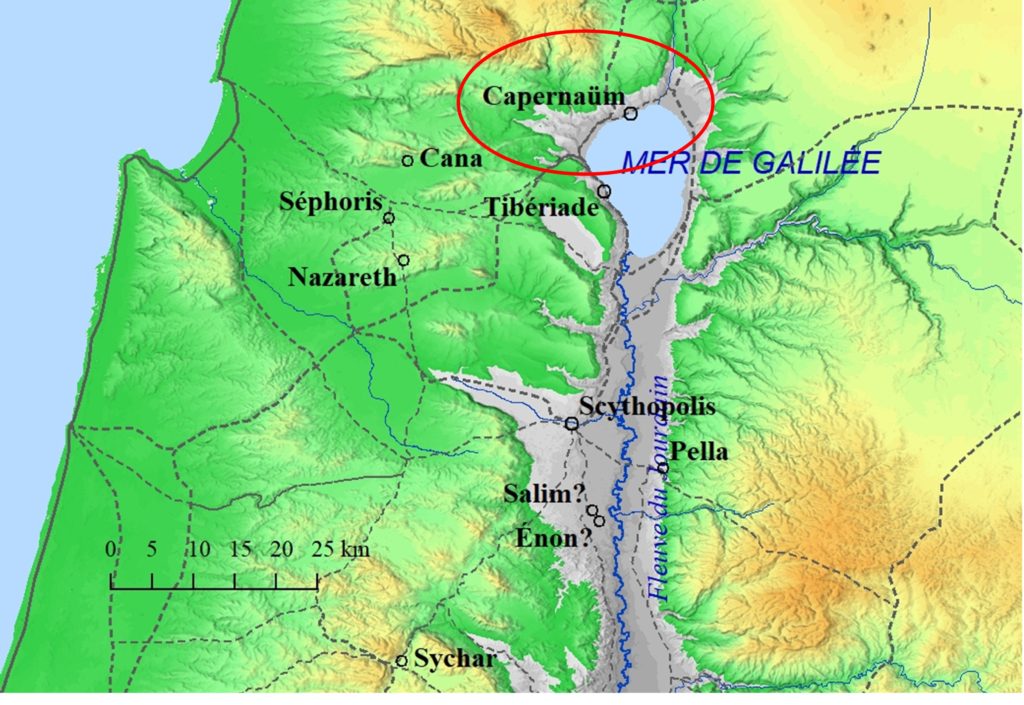
Place: Near the house in Capernaum in Galilee.

Date: October or November AD31

Method: We continue with Luke

Note on the method: Matthew recounts another episode in which the Messiah Jesus addresses the same subject.

Capernaum

These words of the Messiah Jesus may be surprising, for they speak of divisions and struggles, and even of kindling a fire!

The Messiah Jesus as a cause of divisions

Fire

Comments

This passage is significant because it depicts the Messiah Jesus declaring his intention to introduce fire, division, and confrontations. His teaching appears divisive because it necessarily entails choices that may, in some cases, challenge ancestral traditions.

The situation becomes polarized, with those who adopt the new approach on one side and those who reject it on the other. The latter thus become active opponents. This opposition is mainly due to the spiritual forces in conflict during a conversion.

The baptism mentioned in Luke 12.50 seems to refer to his death. This event occupies a central place in the life of the Messiah Jesus and represents a significant ordeal that is difficult to overcome.

After addressing this subject, he expresses his criticisms through . By carefully analyzing the available information, it is possible to predict whether the weather will be fine the next day or whether there will be precipitation. Farmers predicted the weather by observing nature without applying this principle on a spiritual level. Instead of comparing the prophecies with Jesus' actions, they rejected his teaching.

An analysis of the actions and discourses of the Messiah Jesus shows that the kingdom of heaven has drawn significantly closer to humanity. In this context, it is relevant to ask why this evidence is not recognized as such.

Jesus concludes by emphasizing individuals' responsibility before God. He encourages them to turn to the one who can grant forgiveness of sins, reminding them that everyone will have to give an account to God.

In his statements, the Messiah Jesus affirms that the Jewish people have a unique opportunity to avoid divine condemnation. He expresses his concern about the attitude of these individuals, who seem to underestimate the importance of his words.

Matthew addresses the same subject but reaches a different conclusion. He discusses priorities in human life, particularly emphasizing the importance of love for loved ones. However, according to him, this love must not surpass the love a person owes to God.

He urges the individual to overcome challenges, particularly those connected with being a disciple, by prioritizing the kingdom of God over personal interests.

In conclusion, it is stated that even life cannot rival the value of the salvation offered by God. Consequently, whoever sacrifices their life because of their faith will find it again in the kingdom of God.

The teachings of Jesus Christ conflict with the cultural and religious traditions of his time. It is therefore necessary to take a position in response to this divergence.