

PER089

The Sermon on the Mount (5), the Messiah Jesus' relationship with the law

The fifth part of the Sermon on the Mount, this article analyses Jesus' relationship with Mosaic law on the basis of Matthew 5:17–20. Jesus states that he came to fulfil the law fully according to God's original purpose rather than abolish it. He distinguishes Moses' authentic law from the religious traditions added by scribes and Pharisees and warns that their institutionalised righteousness does not lead to the kingdom of heaven.

4 min Sermon on the Mount Mosaic law Jesus and the law fulfilment of the law Pharisees 3 verses 2 books

Resources

Biblical texts

Matthew
Matthew 5.17-20 (King James Version)

Think not that I am come to destroy the law, or the prophets: I am not come to destroy, but to fulfil.

For verily I say unto you, Till heaven and earth pass, one jot or one tittle shall in no wise pass from the law, till all be fulfilled.

Whosoever therefore shall break one of these least commandments, and shall teach men so, he shall be called the least in the kingdom of heaven: but whosoever shall do and teach them, the same shall be called great in the kingdom of heaven.

For I say unto you, That except your righteousness shall exceed the righteousness of the scribes and Pharisees, ye shall in no case enter into the kingdom of heaven.

Mark
Mark (King James Version) not cited in the book
Luke
Luke 24.44 (King James Version)

And he said unto them, These are the words which I spake unto you, while I was yet with you, that all things must be fulfilled, which were written in the law of Moses, and in the prophets, and in the psalms, concerning me.

John
John (King James Version) not cited in the book

Technical details

Bar chart for the year 31

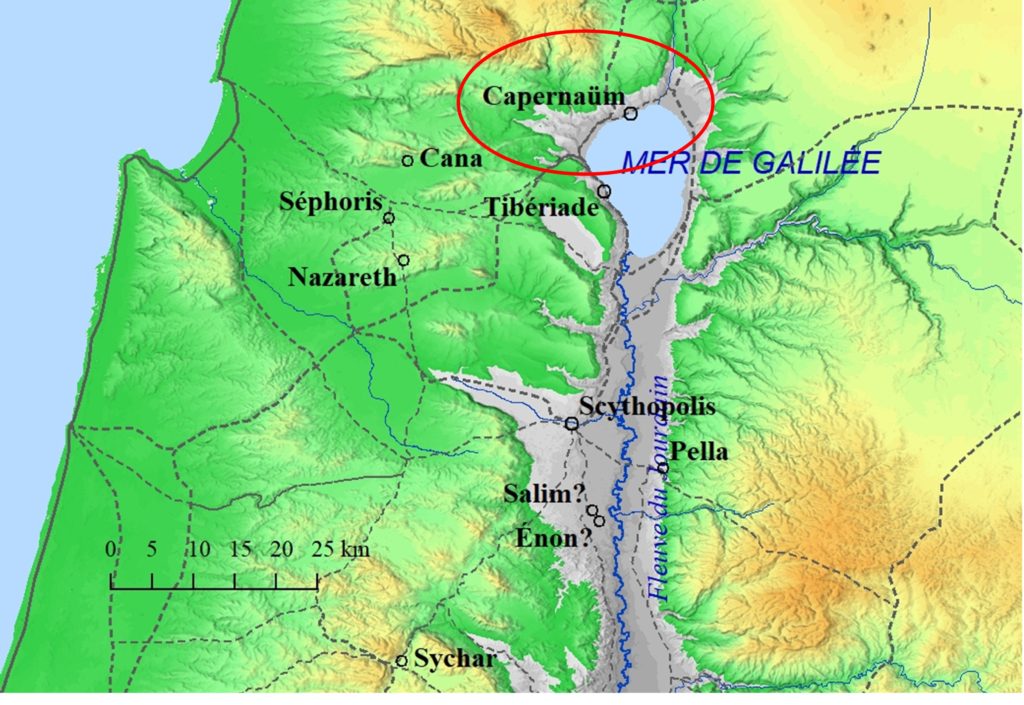
Location: On the plateau below a mountain near Capernaum in Galilee

Date: After the Passover pilgrimage to Jerusalem on April 5, AD 31

Approach: We continue with Matthew.

Note on the approach: Matthew provides the most information, while Luke summarises this discourse more concisely.

Capernaum

The relationship between Jesus the Messiah and Mosaic law.

Jesus the Messiah teaches the crowd

Jesus the Messiah teaches the crowd

Comments

We are examining the Sermon on the Mount, divided into 23 sections.

Matthew reports a series of teachings about the law and the prophets, a crucial subject for first-century Jews, because their society rested on this divine law given to Moses and on the prophets' teaching. Luke, for his part, avoids addressing this subject with Gentiles.

Jesus the Messiah's stance towards this law is essential, since some imagine that he will overturn the entire system. His criticism of the might support the idea of establishing a new order. Yet Jesus states from the outset that he will fulfil the law scrupulously rather than introduce a new system. This seems logical, since God himself gave this law to Moses. In this context, how could the Son of God question its validity?

Jesus therefore proposes a genuine fulfilment of the law as God the Father originally intended. He also specifies that this law will remain until the end of the world and encourages his listeners to observe it scrupulously. It is important to note that Jesus refers to Moses' original law rather than all the precepts added over the years by the various religious authorities.

Jesus concludes unequivocally: unless your righteousness exceeds that of the experts in the law and the , you will not enter the kingdom of heaven. He thus proposes a revolution, affirming that the existing system advocated by the religious men is no longer God's law and leads Jewish society to ruin. In summary, he warns that if your aim is to fulfil this system based on the law and the prophets, you will go straight to hell.

Having made this observation, Jesus clarifies his thought. Addressing foreigners unfamiliar with Mosaic law, Luke does not consider it useful to repeat this point. However, he cites a passage where Jesus proclaims that he came in accordance with what is said in the law and the prophets (Luke 24.44).