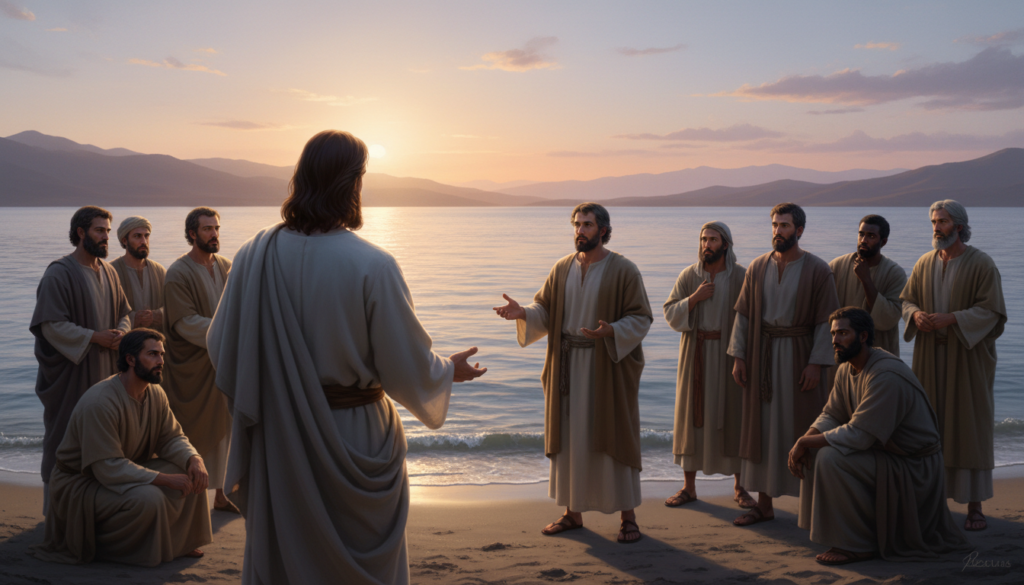
The words of the apostle Peter precisely reflect his deep conviction. Many of Jesus' disciples abandoned his teaching, finding it too hard to follow. The Master then asks the following question: Do you also want to go away?
It was at that very moment that Peter spoke these words. He had understood that the Messiah Jesus had offered him something far greater than temporary blessings. However, the disciples who had left and gone back to their ordinary lives had not grasped the same understanding. For them, following the Messiah Jesus came down to a series of burdensome obligations that were hard to put into practice.
What is the difference between the experience of these men and that of Peter? Did he receive a different grace from the others?
There are two kinds of adherence: a first, superficial one that hopes for an improvement in life, an immediate advantage, but with the risk of giving up everything at the first difficulty. This adherence has no root and no solid foundation, and can quickly collapse in the face of trials, as was the case for some disciples who left their master. They will say: This saying is hard. Who can listen to it?
But there is another kind of commitment: Peter understands that eternal life matters more than life on earth. He focuses on the reward of the kingdom of God, knowing that no treasure down here is worth as much (Matthew 13.44).
The priority we give to our goals influences our journey. If material success is our main concern, we will probably succeed, but we will end up having to leave everything behind (Luke 12.16-20). On the other hand, if we concentrate our efforts on the kingdom of God and the hope of eternal life, and make it our main goal, we will be able to obtain the fruits of eternal life.
This by no means means that we will fail in our lives; it is simply essential to understand that a successful life is one that is guided by high principles, by God.
We would like to draw your attention to the consequences of the choice of these men, those who walked away. By rejecting the teachings of the Messiah Jesus, they rejected the very life he was offering them. King Solomon said the following words to his generation, Ecclesiastes 11.9: "Rejoice, O young man, in your youth, and let your heart cheer you in the days of your youth; walk in the ways of your heart and in the sight of your eyes; but know that for all these God will bring you into judgment."
This path appears easy and attractive, but only for a time. There is another path, narrow and hard, and Matthew 7.13-14 tells us that many follow the easy path but few set out on the narrow one.
These two paths do not lead to the same place. The broad and easy path leads to destruction, while the narrow path leads to eternal life.
The is insatiable for the simple reason that its intrinsic need is spiritual. It needs God first and then the good things of the earth. It is only by respecting this priority that it becomes possible to succeed in life. This is what Peter had understood.
Eternal life in the person of the Messiah Jesus is worth more than the greatest success in this world. Mark 8.36 and Matthew 16.26 proclaim it in a different way: For what will it profit a man if he gains the whole world, and loses his own soul? Or what will a man give in exchange for his soul?"
Dominique Lormier