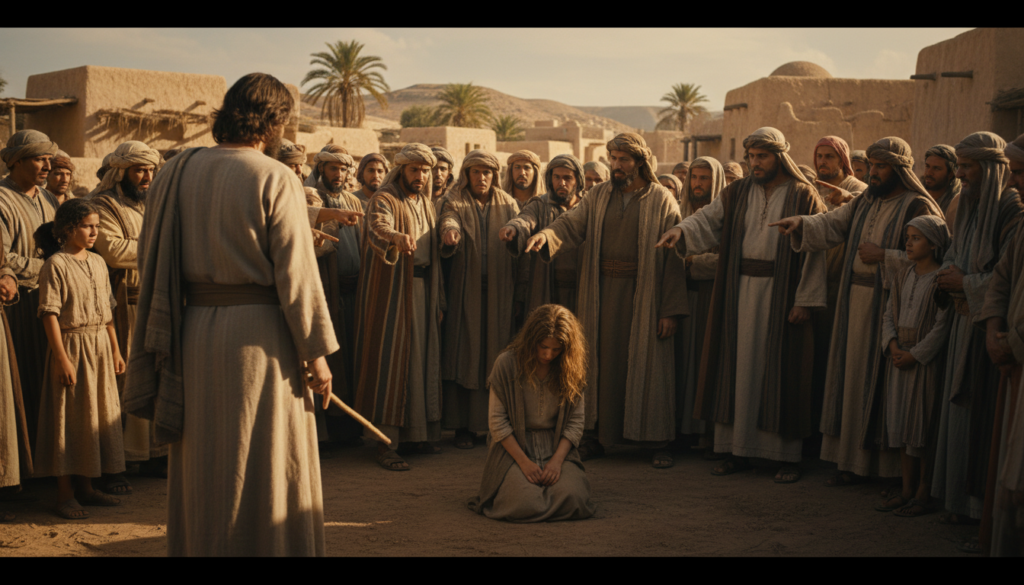
In chapter 8 of the Gospel of John we are told the story of a woman who was caught in the very act of adultery. Religious men had seized her and dragged her mercilessly to the feet of Jesus, who was teaching in the temple at the time, surrounded by a great crowd. They were not motivated by feelings of kindness and forgiveness, but by treacherous intentions.
They wanted to set a trap for Jesus and test him publicly: “Moses, in the law, commanded us to stone such women. So what do you say?” The Lord did not answer right away. Without losing his composure, he wrote on the ground with his finger, and suddenly he simply said, with great nobility of heart: “Let him who is without sin among you cast the first stone at her.”
These few words struck these religious men deeply in their conscience. Uneasy, they all withdrew, leaving the woman with Jesus, utterly stunned to have escaped the .
Since then, the sentence spoken by Jesus has become proverbial. To cast the stone at someone is to blame them and bring accusations against them, when one is not blameless oneself. In the 15th century, another similar expression spread: “to throw stones into someone’s garden,” meaning to accuse them, to attack them with words.
Jesus, for his part, does not accuse and does not condemn. He was the only one who could have cast the stone at the adulterous woman, because he was without sin, and therefore blameless. A few words of compassion were enough for him to bring his holiness to light and accomplish a work of deliverance, for, though he is the Righteous One and the Holy One par excellence, far from despising sinners, he came “to seek and to save that which was lost” (Luke 19/10). Thus he willingly took upon himself the condemnation of sin by giving his life for us on the cross of Golgotha. “He loves, he comforts, he makes me happy,” says the hymn.
Now that he has accomplished his work of love and forgiveness, he leaves us, as he did the adulterous woman, his divine instruction: “go and sin no more” (John 8.11).
Pastor Daniel GUILLET