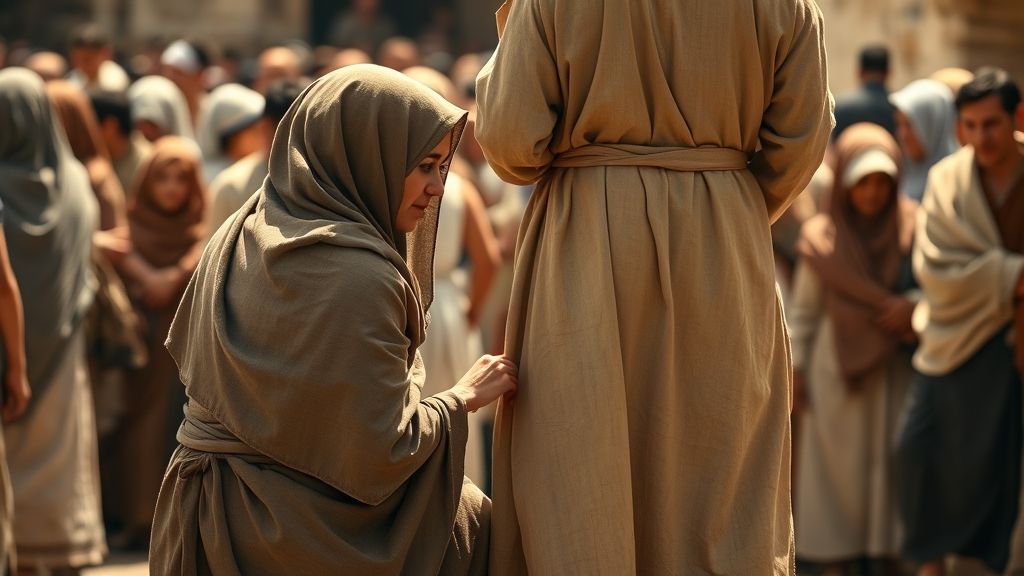
The article explores the account of the woman suffering from bleeding in Matthew, Mark and Luke. Each Gospel presents a slightly different version of the event, highlighting various details while emphasising the woman's faith and Jesus' healing power. The Gospels are brought together to offer a complete view of this event.
Nous avons recueilli ces commentaires sur le site : https://jtpbatiment1.jimdofree.com/. Ce site semble désormais fermé, mais nous avions précédemment noté leurs réserves concernant les Évangiles. Veuillez trouver ci-dessous le Point N°6 CTD064. Nous reproduisons leur question :
"Commentary : Emmanuel a-t-il dit qui a touché mes vêtements ? Ou s’est-il adressé directement à la femme comme le dit Matthieu 9. 20-22 puisqu’ Il l’avait identifié
Là encore deux récits s’opposent."
Notre réponse :
Regardons les textes en question.
20 C’est alors qu’une femme qui souffrait d’hémorragies depuis 12 ans s’approcha par-derrière et toucha le bord de son vêtement,
21 car elle se disait : « Si je peux seulement toucher son vêtement, je serai guérie. »
22 Jésus se retourna et dit en la voyant : « Prends courage, ma fille, ta foi t’a sauvée. » Et cette femme fut guérie dès ce moment.
(Louis Segond translation )
25 Or, il y avait une femme atteinte d’hémorragies depuis 12 ans.
26 Elle avait beaucoup souffert entre les mains de nombreux médecins. Elle avait dépensé tout ce qu’elle possédait, mais cela n’avait servi à rien ; au contraire, son état avait plutôt empiré.
27 Elle entendit parler de Jésus, vint dans la foule par-derrière et toucha son vêtement,
28 car elle se disait : « Même si je ne touche que ses vêtements, je serai guérie. »
29 A l’instant même, son hémorragie s’arrêta, et elle sentit dans son corps qu’elle était guérie de son mal.
30 Jésus se rendit aussitôt compte qu’une force était sortie de lui ; il se retourna au milieu de la foule et dit : « Qui a touché mes vêtements ?»
31 Ses disciples lui dirent : « Tu vois la foule qui te presse et tu dis : ‘Qui m’a touché ?’ »
32 Jésus regardait autour de lui pour voir celle qui avait fait cela.
33 La femme, effrayée et tremblante, sachant ce qui lui était arrivé, vint se jeter à ses pieds et lui dit toute la vérité.
34 Alors il lui dit : « Ma fille, ta foi t’a sauvée. Pars dans la paix et sois guérie de ton mal. »
(Louis Segond translation )
Nous souhaitons examiner les autres documents pertinents liés à cet événement afin de mieux comprendre les circonstances. Nous estimons que chaque auteur apporte une perspective unique et que la synthèse des différents témoignages nous offre une vision plus exhaustive et précise.
43 Or il y avait une femme qui souffrait d’hémorragies depuis 12 ans ; elle avait dépensé tout son bien chez les médecins, mais aucun n’avait pu la guérir.
44 Elle s’approcha par-derrière et toucha le bord du vêtement de Jésus. Son hémorragie s’arrêta immédiatement.
45 Jésus dit : « Qui m’a touché ?» Comme tous s’en défendaient, Pierre et dirent : « Maître, la foule t’entoure et te presse, [et tu dis : ‘Qui m’a touché ?’] »
46 Mais Jésus répondit : « Quelqu’un m’a touché, car j’ai senti qu’une force était sortie de moi. »
47 Voyant qu’elle n’était pas passée inaperçue, la femme vint toute tremblante se jeter à ses pieds ; elle déclara devant tout le peuple pourquoi elle l’avait touché et comment elle avait été immédiatement guérie.
48 Alors il lui dit : « Ma fille, [prends courage,] ta foi t’a sauvée. Pars dans la paix !»
(Louis Segond translation )
Cet épisode n'est pas repris par Jean.
Notre analyse :
Pour comprendre ce texte, il est important de considérer que les auteurs du 1er siècle étaient limités par les contraintes d'espace liées à l'impression. Par conséquent, certains détails ont été omis en raison de ces restrictions.
Selon l'Évangile de Marc, Jésus, le Messie, prononça initialement les mots suivants : « Qui a touché mes vêtements ? ». Par la suite, en identifiant la femme responsable, il lui dit : « Prends courage, ma fille, ta foi t'a guérie ». L'Évangile de Matthieu, quant à lui, résume cet événement sans mentionner la première phrase de Jésus, alors que Marc fournit une description plus détaillée. Il convient de souligner que les Évangiles se complètent mutuellement et que l'examen et la synthèse des quatre textes permettent d'obtenir une interprétation plus complète.
En examinant l'écriture de Luc concernant cet épisode, nous constatons qu'il se rapproche du récit de Marc. Toutefois, il est important de noter que chaque auteur apporte des détails différents dans leurs résumés respectifs afin de maintenir l'intégrité du texte. Partant du principe que Marc avait connaissance du texte de Matthieu, Luc connaissait les textes de Matthieu et de Marc, et Jean était familier avec tous ces textes, ils ont préféré ajouter des informations complémentaires plutôt que de recopier textuellement les récits des autres.
A title, a person, a place, a reference (“Luke 15”)…
opens in a new window
Bible reference
INF352
Information note
INF352 - Those Who Were With Him
Those Who Were With Him
“Those Who Were With Him” (Acts 5.17): Interpretation
The Greek expression καὶ πάντες οἱ σὺν αὐτῷ (“and all those who were with him”) can indeed be interpreted in several ways:
Ideological interpretation (partisans)
This is the most likely interpretation, and Luke himself seems to confirm it by the explanatory apposition:
“The high priest and all those who were with him, that is, the party of the Sadducees (ἡ οὖσα αἵρεσις τῶν Σαδδουκαίων)”
The term αἵρεσις (hairesis) here denotes a “school of thought,” a “party,” a “sect” in the philosophical sense — a group sharing the same doctrinal convictions. The expression “those who were with him” would therefore refer to the members of the Sadducean party in general, those who shared the high priest’s ideology.
Physical interpretation (presence at a meeting)
One could also imagine a small meeting of the high priest’s immediate circle — his close associates, all Sadducees — who would have decided on the arrest before convening the full Sanhedrin (mentioned later in v. 21).
This reading would explain why the Pharisees such as Gamaliel only step in afterward, at the official convening of the Sanhedrin (v. 34).
Both at once?
The two readings are not mutually exclusive. Luke may mean:
The high priest acted with his inner circle (physically present)
This circle was composed exclusively of Sadducees (ideologically united)
This would underline that the initiative for the arrest was a decision of a faction, taken by the Sadducean clan without consulting the whole Sanhedrin — which would explain the moderating reaction of Gamaliel afterward.
Conclusion
The apposition “that is, the party of the Sadducees” suggests that Luke stresses ideological affiliation: it is the Sadducees as a doctrinal group who oppose the apostles. But the narrative context (a decision to arrest followed by the convening of the Sanhedrin) also implies that it was probably a small circle acting on its own initiative, before involving the official assembly.
INF082
Information note
INF082 - The Segond 21 Bible (S21)
The Segond 21 Bible (S21)
The Segond 21. Here is some key information about this version:
Background and aims
Publication date: 2007 Modernisation: The Segond 21 aims to modernise the language of Louis Segond's translation while remaining highly faithful to the original Hebrew and Greek texts. Clarity and accessibility: The emphasis is on making the text clear and accessible to contemporary readers.
Main features
Faithfulness to the original texts: The Segond 21 draws on the most reliable ancient manuscripts to ensure an accurate and faithful translation. Linguistic revision: The language was revised to reflect modern French usage better while preserving the richness and depth of the biblical text. Notes and references: The version often includes explanatory notes and references to help readers understand and study Scripture.
Importance
Widespread use: The Segond 21 is widely used in French-speaking Protestant circles, particularly for Bible study and personal reading. Accessibility: Its modernised language makes it accessible to a wider audience, including new generations of readers.
The Segond 21 was produced by a multidisciplinary team of translators, linguists and theologians and took approximately twelve years of work to complete.
These revisions show how Louis Segond's translation has evolved to adapt to linguistic changes and readers' needs over time.