ANN119

The eschatological discourse on the Mount of Olives

This article explores Jesus’ eschatological discourse on the Mount of Olives, discussed in the Gospels of Matthew, Mark and Luke. Jesus warns his disciples about future events, encouraging vigilance in faith. The study examines the synoptic accounts in depth, particularly Matthew 24.

33 min eschatological discourse end times Jesus 20 verses 4 books

Further information

Introduction

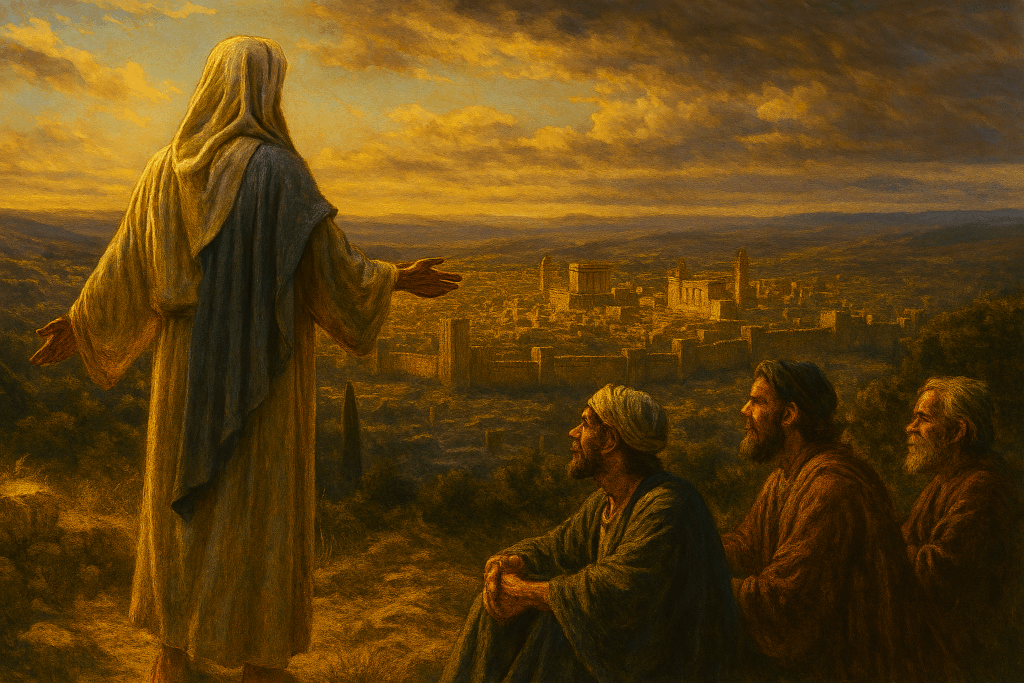
Shortly before his arrest, the Messiah Jesus delivers a major discourse concerning the end times and his own return. He is then on the , east of Jerusalem. From this vantage point he has a breathtaking view of the holy city and of the temple, whose beauty and splendor are remarkable. Yet the content of his discourse stands in sharp contrast to the calm of the surrounding landscape and the tranquility he shares with his disciples. Indeed, the Messiah Jesus announces many upheavals and catastrophes to come, giving his words a tone that is far from reassuring.

This is not the first time the Messiah Jesus has addressed the theme of the end times. Earlier, on the road to Bethany beyond the Jordan, he had already spoken of this subject. At that moment he had just left Jerusalem, accompanied by his disciples and a large crowd.

These events have already been dealt with in the pericopes PER252 – The Messiah Jesus announces his second coming , where the Messiah Jesus announces his second coming, and PER299, which reports the eschatological discourse on the . The aim of this study is therefore to go deeper into all the information contained in these texts. It also seeks to compare the three synoptic accounts that report this discourse, and to examine Luke’s second account devoted to this theme.

I. The text of Matthew

Le récit présenté par Matthieu se distingue par sa longueur exceptionnelle : il comprend quarante-neuf versets et totalise 1 079 mots dans la traduction Segond . Cette ampleur témoigne de l’importance particulière que Matthieu a accordée à cette annonce du Messie Jésus. La densité et la richesse du texte montrent la volonté de l’auteur de développer en détail cet épisode crucial.

The choice to begin with Matthew’s account rests on the conviction that this Gospel was the first to be written. This priority suggests that Mark and Peter, when writing the second Gospel, already had access to Matthew’s text. Their aim was therefore not to compose an isolated account, but to confirm Matthew’s and, where necessary, to add to it. This process shows the existence of continuity and interaction between the Gospel accounts, each author taking part in a dynamic of confirming and enriching the original testimony.

With this in view, it is appropriate to analyze Matthew’s text in depth. To keep this appendix lighter, some analyses will be written separately and made accessible through hyperlinks, allowing easier and more targeted consultation of the various aspects addressed.

Analysis of .3-51

The Messiah Jesus, addressing his disciples, aims to warn them about the events to come. He gives them no precise date for the fulfillment of these things, reminding them that only God the Father knows that moment. However, he describes a political and historical context that is meant to serve as a landmark for believers. Thus, when his disciples see these signs occur, they must understand that the return of the Messiah Jesus is near, as he says in .33. It is also important to note that Jesus is speaking specifically to his disciples, who are Jews, and that the events mentioned remain centered on Israel.

The attitude to adopt in the face of the signs is therefore:

_Observe with discernment: Jesus calls for careful observation of the signs, without giving way to fear or speculation.

_Watch with faith: Even though the coming of the Son of Man remains unpredictable, one must stay vigilant in faith, for this coming is certain.

_Read the signs in the light of the Gospel: The signs are not to be seen as codes to be deciphered, but rather as calls to faithfulness and perseverance in faith.

In what follows, we will examine the text of Mark in the same way, and then compare the passages of Matthew 24.3-51 and Mark 13.1-37.

II. The text of Mark

The Gospel according to Mark presents here a passage whose length departs from the author’s usual style, which generally favors short, concise accounts. This discourse, which runs to 37 verses and totals 855 words, is nevertheless 21% shorter than the parallel account as reported by Matthew.

This relative brevity takes nothing away from the considerable importance the author attaches to this discourse. The fact that Mark, no doubt in connection with Peter, chose to condense Matthew’s text while keeping it in his Gospel underlines the exceptional significance of these words for the community he is addressing.

It is therefore worth asking: beyond the shortening of the text, did Mark and Peter introduce new elements in their version of the discourse? This question belongs to a broader reflection on how each evangelist adapts and transmits the words of Jesus according to his theological intentions and the context of his readers.

Analysis of .1-37
Synthesis of the text of .1-37

III. The text of Luke

Le récit de Matthieu, dans la traduction Segond , se distingue par sa longueur et sa richesse en détails : il compte 49 versets et totalise 1 079 mots. Cette version offre ainsi une exposition plus étendue du discours du Messie Jésus.

By comparison, the evangelist Mark offers an account of 37 verses and 855 words. Mark’s text is therefore about 21% shorter than Matthew’s, which reflects a more concise and condensed narration on his part.

Luke, for his part, presents the shortest version of the discourse: his account has 32 verses and 730 words in the same translation. Luke’s brevity may be explained by the fact that he had already reported another discourse of the Messiah Jesus on this same theme in Luke 17.22-37. Luke therefore did not think it necessary to repeat elements he had already addressed, which accounts for the brevity of his passage here.

Nevertheless, the respective length of the accounts in the synoptic Gospels, as well as the fact that all three authors report this discourse, underline the importance of the subject in their eyes. Matthew and Peter were present at the discourse, while Luke relies on his notes and on the texts of Matthew and Mark, as well as on the results of his own research. Luke, being the last to write this text, has these elements at his disposal to enrich his testimony.

It therefore appears clearly that the subject treated is of crucial importance according to these three witnesses, and their respective approaches bear witness to the attention paid to this discourse of the Messiah Jesus.


IV. The general synthesis

Here is a general synthesis of the eschatological discourses of Matthew 24.3-51, Mark 13.1-37 and Luke 21.5-36, in order to draw out their theological, spiritual and narrative essence. These three texts, parallel yet distinct, form a powerful triptych on the end times, the coming of the Son of Man, and the believer’s attitude toward history.

A common structure: three movements

The three evangelists organize their account in a dramatic progression in three stages:

The preliminary signs: worldwide upheavals, spiritual deception, persecutions, proclamation of the Gospel.

The great distress: the abomination of desolation (Matthew and Mark), the siege of Jerusalem (Luke), the call to flee, unequaled suffering.

The coming of the Son of Man: cosmic signs, the glorious appearance of Christ, the gathering of the elect.

To this is added a final call to vigilance, often illustrated by the of the and by exhortations to watch, pray and remain faithful.

Converging points: the heart of the message

All three insist on: the deception of false messiahs and the need for discernment.

The trial of bearing witness: the disciples will be handed over, betrayed and hated, but are called to persevere.

The invisibility of the divine timetable: the day and the hour are unknown, even to the Son.

The sudden and universal coming of the Son of Man, like lightning.

The call to vigilance: staying awake, not letting oneself be weighed down by worries or pleasures.

The promise of salvation for those who persevere and stand before the Son of Man.

These elements form an eschatological catechesis: not to predict, but to prepare.

Distinctive nuances of each Gospel

Matthew develops a moral and communal catechesis :

He stresses the progression of evil and the cooling of love.

He introduces images of separation (one taken, one left) and the of the faithful servant.

He emphasizes the universal proclamation of the Gospel before the end.

Mark, more restrained, conveys a missionary tension :

He names the four disciples present.

He stresses the role of the Holy Spirit in bearing witness.

He concludes with a universal exhortation: “What I say to you, I say to everyone: watch.”

Luke, more pastoral, links the discourse to future history :

He prophetically describes the siege of Jerusalem (Luke 21.20).

He stresses the distress of the people, the divine wrath, and the end of the times of the Gentiles.

He calls us to guard our heart, to pray at all times, and to stand before the Son of Man.

Theological essence

These three accounts do not seek to establish an apocalyptic timetable, but to form a spiritual awareness able to pass through history with faith. They teach that:

Evil does not triumph, but it precedes the revelation of Christ.

Salvation is personal, but also communal: it comes through witness, perseverance and faithfulness.

The Kingdom is coming, but it demands active waiting, inner vigilance and a clear-sighted hope.

The essence is therefore an ethic of waiting: living each day as if the Kingdom were at the door, without fear, without flight, but with faith, clarity and love.

V. Luke’s second account

It is essential to stress that Luke records two discourses of the Messiah Jesus dealing with the theme of eschatology. This double mention testifies to the importance Luke gives to this subject in his account.

The first discourse takes place while Jesus, accompanied by his disciples and a great crowd, is leaving Jerusalem for Bethany, beyond the Jordan. This moment comes before the , on December 15, AD 32. At one point, Jesus addresses his disciples in a particular way, giving them specific teachings on eschatology.

The second discourse takes place on the , a few days before Jesus’ arrest (cf. Mark 14.1). This particular context adds a further dimension to the words of the Messiah concerning the end times and heightens the evangelist’s interest in this theme.

The aim is therefore to analyze this last discourse and to compare the two eschatological addresses reported by Luke, in order to highlight their common points and their distinctive features.


VI. What does Luke 17.37 mean?

Luke 17.37 is a brief, enigmatic and especially evocative verse. It forms the conclusion of the eschatological discourse reported in Luke 17.22-37, ending on a striking image:

“The disciples asked him, ‘Where, Lord?’ He answered them, ‘Where the body is, there the vultures will gather.’”

This passage stands out for its suggestive power: to the disciples’ question about the place where these events will happen, the Messiah Jesus answers with an image rather than a precise indication. The choice of symbol, vultures gathering around a body, evokes the certainty and inevitability of judgment. The image does not point to a particular geographical place, but stresses that judgment comes where evil has reached maturity.

This saying is also found in Matthew, more precisely in Matthew 24.28, in a similar context:

“Where the corpse is, there the vultures will gather.”

In the Gospel according to Matthew, this statement follows closely upon the announcement of the sudden coming of the Son of Man, compared to lightning that flashes forth (Matthew 24.27). Likewise, in Luke, it concludes a series of images on the suddenness of judgment.

The final image used by Jesus has given rise to many interpretations. However, in the context of Luke, it belongs to the perspective of judgment: where evil is accomplished, judgment comes certainly and naturally, without any need to specify the place. The emphasis is thus placed on the spiritual and existential dimension of the event, rather than on its location in space.

What does this image mean?

The image used by the Messiah Jesus, that of vultures gathering around the corpse, is deliberately provocative and highly symbolic. This enigmatic saying has given rise to various interpretations over time, the main ones of which follow.

1. Inevitable judgment

Just as vultures are inevitably drawn to a corpse, God’s judgment is manifested where evil has reached maturity. This is not a precise geographical place, but a certain, natural and irreversible reality. Thus, to the question “Where?”, the answer is clear: judgment will come where it must come, according to the intrinsic logic of divine justice.

2. The revelation of the Son of Man

Some Church Fathers proposed a different reading, seeing in the “body” an allusion to the crucified Christ, and in the “vultures” the believers who gather around him. However, in the immediate context of Luke 17, this interpretation seems less relevant: the tone of the passage is not one of consolation but of judgment.

3. Spiritual discernment

The image also suggests that the signs of judgment are perceptible to those who know how to recognize them. Just as the presence of vultures in the sky announces the death of an animal on the ground, spiritual signs precede the revelation of the Kingdom. It is therefore necessary to watch, to discern and not to remain in blindness.

The meaning of Jesus’ answer to the question “Where?”

When the disciples ask the Messiah Jesus about the place where these events will occur, precisely where the distinction between “one taken and the other left” will be made, the Messiah Jesus declines to give them any geographical indication. His answer, entirely symbolic, shows that judgment does not depend on a particular place, but on the spiritual state of the individuals concerned.

In summary

Luke 17.37 is a saying marked by discernment and gravity. This verse first underlines an inevitable reality: judgment comes precisely where evil has reached its full accomplishment. Like vultures gathering around a corpse, judgment does not appear at random, but heads inexorably toward what has reached its final corruption.

Another essential aspect of this saying lies in the invisible dimension of judgment during its preparation. Although its signs may escape immediate notice, its fulfillment remains certain and irresistible. The process of judgment follows an inner logic, being accomplished according to a spiritual necessity that often escapes direct observation.

The question is therefore not to identify an outward place where this judgment will occur, but to understand how to prepare for it inwardly. This verse invites everyone not to look for geographical or temporal landmarks, but to concentrate on the disposition of their own heart and on the spiritual vigilance to be cultivated.

Finally, the saying of Luke 17.37 concludes the discourse of Luke 17.22-37 like a dramatic punctuation mark. It leaves the reader in a state of spiritual tension: it is a call to watchfulness, to discernment, and to awareness of the fragility of what is destined to pass away. The reader is invited not to cling to what is perishing, but to turn attention toward what remains.

VII. Commentary

The texts of Matthew 24.3-51, Mark 13.1-37, Luke 21.5-36 and Luke 17.22-37 address a central theme, one often raised by the disciples: the end times and the return of the Messiah Jesus. These passages bear witness to the disciples’ concern about the course of the events that will precede this awaited return.

The Messiah Jesus passed on to his apostles and disciples information deemed essential concerning the end times. The authors of the synoptic gospels reported these words faithfully, anxious to preserve the full scope and importance of the teachings given by the Messiah Jesus. These texts thus constitute a major reference for understanding the expectations and spiritual landmarks connected with the coming of the Kingdom.

A few years later, the apostle Paul deepened some of the aspects mentioned by the Messiah Jesus. His development of the initial revelations helps to complete and enrich the disciples’ understanding of the sequence of events leading to the return of the Messiah Jesus.

To grasp fully the meaning and coherence of these teachings, it is important to consider all the passages concerned. Only a cross-reading and a placing in perspective of all these texts make it possible to obtain a realistic and coherent view of the times to come, as it is presented from the biblical perspective.

Several chapters and appendices deepen the study of biblical prophecies and their connection with contemporary events:

The land of Israel today

This chapter offers an analysis of the prophetic texts announcing the return of the Jewish people to their land. It highlights how these prophecies find an echo in Israel’s present reality, thus offering landmarks for understanding the spiritual and historical stakes of this return.

The end of conflicts

In this chapter, the emphasis is placed on the biblical teaching concerning the Israeli-Islamist conflicts observed in our time. The study seeks to show how the Scriptures shed a unique light on the persistence and significance of these tensions, while inviting a careful reading of their development in the light of the biblical text.

The return of Jesus the Messiah

This chapter gathers information from the Gospels relating to the return of the Messiah Jesus. It sets out the teachings of Jesus on this awaited event, underlining the signs that precede it and the scope of his words for the disciples of yesterday and today.

Appendix ANN101: Prophetic sequence of the end times

Appendix ANN101, prepared by Pastor Alain Michel Trichard, offers a complete overview of the New Testament texts announcing the end times. It makes it possible to grasp the coherence of the biblical message concerning the sequence of eschatological events.

Appendix ANN102: The signs announcing the return of the Messiah Jesus

Finally, appendix ANN102 lists and details the signs mentioned in the Scriptures that announce the return of the Messiah Jesus. It is a valuable tool for discerning the characteristic elements of this particular period from the biblical perspective.

Events related to Israel are currently undergoing a particularly striking acceleration. A significant milestone was reached on October 8, 2025, with the signing of the peace plan initiated by U.S. President Donald Trump. This plan, already presented publicly on September 29 at a press conference at the White House in the presence of Israeli Prime Minister Benjamin Netanyahu, saw several twists in its acceptance by the parties concerned.

At first, Hamas had rejected certain conditions of the plan. However, the movement ended up accepting these provisions on October 3, an acceptance that notably included the release of the hostages. This gesture, broadcast widely on television, allowed the whole world to witness it directly.

The first concrete phase of this plan for Gaza took shape on Monday, October 13, 2025: the last 20 living hostages held by Hamas were released. This result is the fruit of an agreement providing, in exchange, for Israel to release nearly 2,000 Palestinian prisoners. This exchange represents an important step in the implementation of the peace plan and illustrates how quickly the situation in the region is changing.

Following these advances, U.S. President Donald Trump says he sees the opening of a period of peace covering the entire region. This statement resonates particularly with readers of the Bible, immediately echoing the passage of 1 Thessalonians 5.3: “While people are saying, ‘Peace and safety,’ destruction will come on them suddenly, as labor pains on a pregnant woman, and they will not escape.”

Recent events seem to indicate that many biblical prophecies are currently being fulfilled. According to the sacred texts, the appearance on the international stage of a man coming from the nations is announced. This individual will stand out for an exceptional ability to influence the world and will be recognized as a peacemaker. His contribution to social stability on a planetary scale will earn him international recognition and veneration, to the point that many peoples will place their trust in him.

Careful observation of these facts highlights how biblical announcements once seen as hardly achievable now find an echo in historical reality. The rapid succession of contemporary events sheds new light on the ancient texts, underlining their relevance and timeliness.

The authority exercised by this man will extend over a period of three and a half years, a phase marked by trust and hope for many peoples. This duration corresponds precisely to what the biblical texts describe, illustrating how ancient predictions can suddenly fit into the course of history.

However, at the end of this first period of three and a half years, the Bible announces a radical change of attitude in this man. He will then turn against the Jewish people with extreme brutality. This new phase, called the “great tribulation,” will likewise last three and a half years. According to the prophecy, it is at the end of these seven years in all that the glorious return of the Messiah Jesus will occur.

A rigorous analysis of the signs described in the texts suggests that the fulfillment of this prophecy could be imminent. The Gospels in particular invite the disciples to remain vigilant, to keep hope and to prepare, for the promised deliverance now seems to be within reach.

Conclusion

For people today, it is essential to know the texts of the Bible not for the purpose of accumulating knowledge, but to draw connections between these ancient words and the geopolitical facts unfolding at present, on this October 15, 2025. This approach consists in observing how present events seem to echo words spoken nearly two thousand years ago.

Indeed, it is legitimate to ask how statements made by the Messiah Jesus, around December 15, AD 32 and repeated on March 30, AD 33, can today find a visible fulfillment. Everyone is free to interpret these facts from their own perspective, but the number of major points that are being fulfilled in accordance with the biblical text invites us to question the notion of chance. A rational, Cartesian mind would be entitled to examine this information objectively in order to draw an informed analysis from it.

It should be stressed that it is not possible to predict the precise date of the return of the Messiah Jesus, an event associated with the end of the world as we know it. However, it is relevant to ask about the historical period we are going through, particularly in connection with Israel and the Middle East. The question remains: are we close to this return?

As it is written:

Matthew 24.33 (King James Version) :
So likewise ye, when ye shall see all these things, know that it is near, even at the doors.