ANN111

The destination of the disciples after the multiplication of the loaves

The article explores the divergent accounts in the Gospels concerning the destination of the disciples after the multiplication of the loaves, analyzing the perspectives of Matthew, Mark and John. It proposes a coherent reconstruction of the episode, taking into account the historical and theological context.

19 min multiplication of the loaves disciples Gospels 17 verses 4 books

Further information

Introduction

It is not always easy to reconstruct the journey of Jesus and his disciples. The authors of the Gospels sometimes provide different information, which can give the impression of a contradiction. However, it is necessary to analyze this information in order to find a coherent explanation.

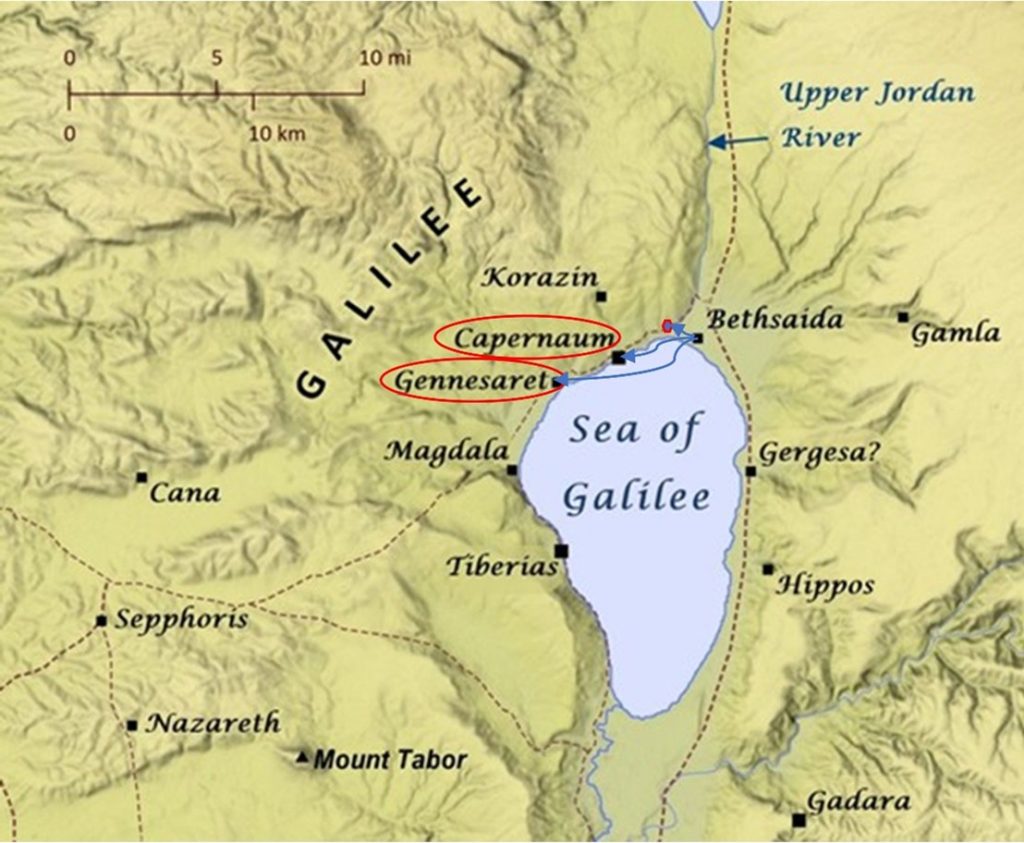
This issue arises when the disciples, at Jesus' command, leave where the Master multiplied the loaves. Were they on their way to according to Mark 6.45, to Capernaum according to John 6.16-21, or to Gennesaret according to Matthew 14.34?

We will carry out an exhaustive examination of all the information in order to analyze it and try to discern the intentions of each author.

I. The information from Matthew

We will present the information in the chronological order in which the four Gospels were written, that is, according to our conclusions, Matthew, Mark, Luke and John.

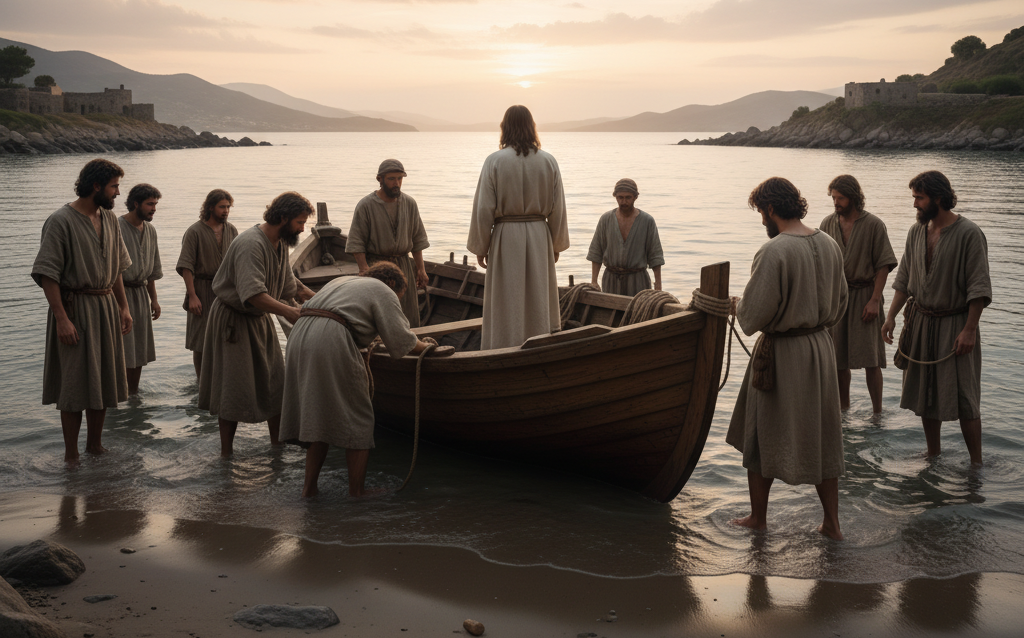
In this passage, Matthew does not initially state the purpose of the journey; he simply mentions that the Messiah Jesus instructed the disciples to go ahead of him to the other shore. It is clear that the disciples understood this instruction and took a boat. Instead of following the coast, they found themselves in the middle of the lake at some point. Given the unfavorable weather conditions, notably the storm, it is likely that the disciples were unable to steer the boat as they would have wished.

The return of the disciples

They finally arrived in the region of Gennesaret. The expression:

Matthew 14.34 (King James Version) :
And when they were gone over, they came into the land of Gennesaret.

may indicate that they could no longer see the coast and that the journey did not go as planned. It is noted that they landed in the region rather than at the harbor of Gennesaret, which shows that they came ashore wherever they could, probably relieved to be back on dry land.

It is possible that they were simply seeking a moment of calm, which would explain their choice of landing place. However, the crowd quickly found them again, and Matthew describes the incessant activity of Jesus and his disciples, while the multitude was certainly arriving in great numbers.

II. The information from Mark

We now examine the information provided by Mark, the scribe of Peter, who was present during this adventure. It does not mention the episode in which Peter walks on the water.

The took place in the region of (Luke 9.10-17). Mark, who knows Matthew's account, also mentions the other shore and adds .

The other shore probably refers to that of the Jordan. A boat was needed to cross the Jordan which, in the time of Jesus, poured more water into the . It is conceivable that extended as far as the west bank of the Jordan, thus into Galilee. The city thus included lands in the Decapolis and in Galilee, with the river as its boundary.

III. The information recorded by Luke

Luke 9.10 indicates that Jesus and his disciples, who had returned from their journeys, withdrew near to rest. However, the crowd found them and gathered to listen to the Messiah Jesus and to benefit from his healing abilities.

Although Luke does not state it explicitly, the scene takes place on the west bank of the Jordan, in the province of the Decapolis (Mark 6.45). Luke relates only the event of the and then moves on to another subject without guaranteeing a formal chronology. He mentions neither their return nor the episode in which the Messiah Jesus and Peter walk on the water.

IV. The information reported by John

John gives us information that complicates the situation: he states that the disciples were to go to Capernaum (John 6.17).

According to John's account, the took place on the other side of the Sea of Galilee, also called the Sea of Tiberias. This terminology can be understood as follows: Jesus and his disciples left the region of Galilee to go to the Decapolis, thus crossing the upper Jordan. This interpretation is in agreement with the writings of the synoptic gospels.

However, after the , it is stated in John 6.17 that the disciples head toward Capernaum, and not toward or Gennesaret.

The wind was blowing violently, probably a west wind that prevented them from reaching their initial destination. We note that they do not use the sail because of the force of the wind, but use the oars. They covered about 25 or 30 stadia, approximately 5 km.

However, how should the verse of John 6.21 be interpreted?

This summary seems to contradict the text of Matthew 14.32, which clearly states that Jesus and Peter got into the boat. We will come back to John 6.21 in our explanation.

Following John's account we find:

John states that the crowd looks for the Messiah Jesus in the direction of . Boats from Tiberias also arrive at this place, but they do not find the Master. The crowd then goes to Capernaum, the headquarters of Jesus and his apostles.

According to John 6.24-25, it seems that Jesus was not found in Capernaum. They continue their search and finally find him on the other side of the lake, in Galilee. John then places the discourse on the bread of life and specifies that these words were spoken in the of Capernaum (John 6.59).

John therefore does not specify exactly where the crowd found Jesus and his apostles; he simply mentions: “They found him on the other side of the sea and said to him” (John 6.25).

V. Establishing a chronology of events

We are frequently faced with a lack of detail, as well as the authors' desire to favor the development of ideas over adherence to a strict chronology. The elements reported by Matthew, Mark, Luke and John are accurate but require a thorough explanation.

  • The took place in the region of , located on the eastern bank of the upper Jordan. Jesus, accompanied by his apostles, took a boat to cross the river. Several other boats followed their movement.
  • At the end of the event, the Lord asks his apostles to return alone to in Galilee, in the western part of that city. They only had to cross the Jordan river. They were therefore not concerned about how the Master would rejoin them.
  • As they began to row to cross the river, a storm drove them away from the shore. Despite their efforts, they covered about 5 km and had to abandon their initial goal of in Galilee.
  • While they were out on the open water and having great difficulty mastering the situation, they saw the Master walking on the water. This event made the already critical situation even worse.
  • Peter steps in, as so often happens, and proposes to join the Master by walking on the water. Although this attempt begins well, it ends in failure. However, the Messiah Jesus takes hold of him, and the two of them get into the boat.
  • At that very moment the storm calms and everything returns to normal. They land between Gennesaret and Capernaum, at a place that has no specific name. The people of Gennesaret, having surely seen the boat land, head toward the spot; the other boats that came from notice the boats on the shore and understand that the Messiah Jesus is at that place. They come to swell the crowd.
  • A dialogue begins, and the group heads toward Capernaum, where the Messiah Jesus will give his discourse on the Bread of life. It seems obvious, however, that all these people could not enter the of Capernaum. We therefore think that the Messiah Jesus first addressed the crowd, before clarifying his thought in the in the presence of the religious authorities.

VI. How should John's description be interpreted?

John 6.21: They were willing, then, to take him into the boat, and immediately the boat reached the land where they were going.

John presents a summary of the event in a concise manner, which can make his words difficult to interpret. As regularly noted, the truth emerges from the synthesis of the various documents. There is no error, but some points require clarification.

Constrained by the brevity of the description, John mentions several essential elements: Jesus walking on the water, getting into the boat, the storm calming, and the disciples landing. It is important to note that John avoids repeating information already written by his colleagues, preferring to bring new details. He highlights the search of the crowd, perplexed as to how the Messiah Jesus had crossed the river to reach the western region.

The sentence of John 6.21 implies that the Messiah Jesus and Peter got into the boat, after which the storm calmed. The disciples then noticed that they were not very far from the shore and were able to land quickly and find dry land again. They then questioned one another about the events they had just experienced.

This situation shows that there could be several interpretations due to a lack of detail. Some commentators on the Bible suggest that the landing of the boat was miraculous, but a linguistic interpretation of John could offer a simpler explanation.

Conclusion

This passage emphasizes that the texts of the Gospels can sometimes present difficulties of understanding for the attentive reader. These apparent divergences between the different accounts can give rise to a feeling of perplexity. It is essential to remember that there are no contradictions within these accounts, all the more so since the authors, notably John, were direct witnesses of the events they relate. It would be unreasonable to think that John, knowing the writings of his companions, would have introduced inconsistencies. In reality, these authors did not aim to synchronize their accounts but rather to relate their experience faithfully. They were aware that each expressed the truth in his own words, and this truth cannot be contradictory.

The researcher's role is therefore to analyze the logic proper to each author in order to reconstruct a harmonious and coherent description of the events.