

Matthew, alone among the evangelists, gives us these lines of rare intensity. His gaze penetrates the hearts of the religious men of his day: guardians of the Law, sure of themselves, yet blind to the light. Through his words, Matthew unveils a disturbing truth: the message of the Kingdom is not flattery for the powerful, but an urgent call to repentance, even for those who believe they already know everything about God.
Matthew 21.28-32
The condemnation Jesus pronounces is not that of an inflexible judge, but that of a physician wounded by his patients’ unbelief. He does not close the door; on the contrary, he leaves it wide open. Yet he announces that others will go first: repentant sinners, tax collectors and prostitutes, those despised souls who nevertheless welcomed mercy with a broken heart.
Matthew 21.31
The proud teachers of the Law will not be excluded, but they will enter only after acknowledging their error, in the humility of a sincere repentance.
Luke 18.9-14
They then understand that, in the of the two sons, the second son, the one who promised but did not obey, represents them. They professed their devotion to God, but refused to obey his will when the Son himself stood before them.
Matthew 21.30
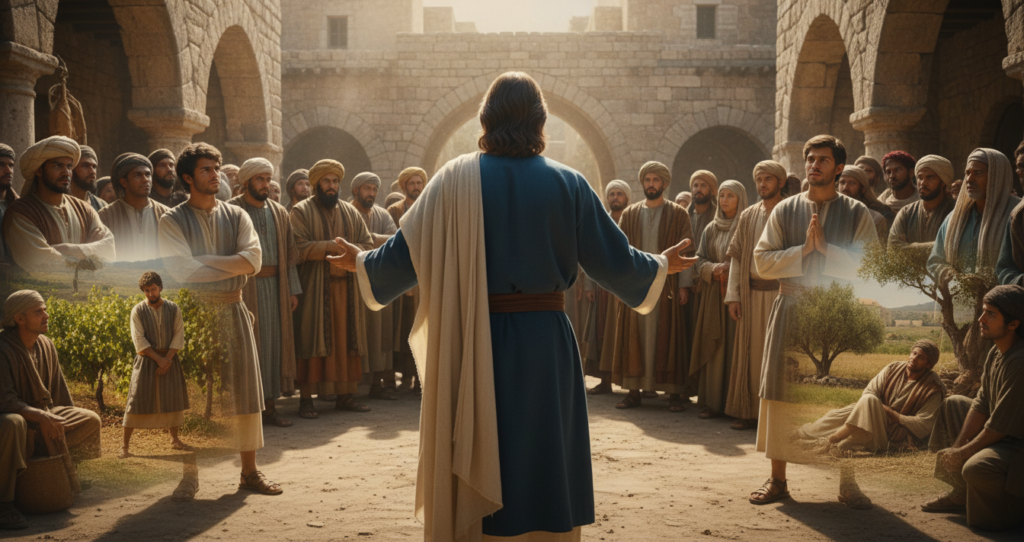
The scene is poignant. Around Jesus the crowd presses in: simple men and women, their faces weathered by life, lend an ear. They understand. They sense the gentleness and strength that radiate from his voice.
And while the seethe in silence, the people rejoice to see the truth burst forth, radiant and liberating. These religious men, so sure they were Israel’s guides, are exposed. They had wanted to teach, and now they are the ones being taught.
Mark 12.37
In the same breath of the Spirit, Matthew extends this revelation beyond the moment. In his chapter 13, he gathers six parables, precious jewels offered for the meditation of believers.
The sower, patient and generous, who scatters the Word on every soil, good or bad.
Matthew 13.3-23
The weeds among the wheat, which remind us that judgment belongs to God alone.
Matthew 13.24-30
The mustard seed and the leaven, symbols of a Kingdom that is discreet yet irresistible, growing in silence.
Matthew 13.31-33
The hidden treasure and the pearl of great price, images of the joy of the one who discovers the true good and gives up everything to possess it.
Matthew 13.44-46
The net cast into the sea, which gathers all kinds of fish until the day when justice will separate the righteous from the wicked.
Matthew 13.47-50
These parables are like the heartbeats of the Kingdom of God.
They teach that salvation is obtained neither by birth, nor by knowledge, nor by apparent perfection, but by humility, faith and listening to the Master.
John 3.16-17
Romans 10.9-10
For it is in the silence of the repentant heart that the true journey toward the Kingdom begins.
Matthew 5.3