

PER279

Return to Jerusalem and stop at Bethphage

The article examines Jesus’ arrival at Bethphage, a strategic stop before Jerusalem. Jesus sends two disciples to fetch a colt in order to fulfil a messianic prophecy. Bethphage, the "house of figs", is crucial in the Gospel narratives.

4 min Jerusalem Bethphage Jesus prophecy colt 4 verses 4 books

Resources

Biblical texts

Matthew
Matthew 21.1-5 (King James Version)

And when they drew nigh unto Jerusalem, and were come to Bethphage, unto the mount of Olives, then sent Jesus two disciples,

Saying unto them, Go into the village over against you, and straightway ye shall find an ass tied, and a colt with her: loose them, and bring them unto me.

And if any man say ought unto you, ye shall say, The Lord hath need of them; and straightway he will send them.

All this was done, that it might be fulfilled which was spoken by the prophet, saying,

Tell ye the daughter of Sion, Behold, thy King cometh unto thee, meek, and sitting upon an ass, and a colt the foal of an ass.

Mark
Mark 11.1-3 (King James Version)

And when they came nigh to Jerusalem, unto Bethphage and Bethany, at the mount of Olives, he sendeth forth two of his disciples,

And saith unto them, Go your way into the village over against you: and as soon as ye be entered into it, ye shall find a colt tied, whereon never man sat; loose him, and bring him.

And if any man say unto you, Why do ye this? say ye that the Lord hath need of him; and straightway he will send him hither.

Luke
Luke 19.28-34 (King James Version)

And when he had thus spoken, he went before, ascending up to Jerusalem.

And it came to pass, when he was come nigh to Bethphage and Bethany, at the mount called the mount of Olives, he sent two of his disciples,

Saying, Go ye into the village over against you; in the which at your entering ye shall find a colt tied, whereon yet never man sat: loose him, and bring him hither.

And if any man ask you, Why do ye loose him? thus shall ye say unto him, Because the Lord hath need of him.

And they that were sent went their way, and found even as he had said unto them.

And as they were loosing the colt, the owners thereof said unto them, Why loose ye the colt?

And they said, The Lord hath need of him.

John
John (King James Version) not cited in the book

Technical details

Year AD 33

Location: Village of Bethphage

Date: Sunday, March 27, AD 33

Method: We continue with Mark

Note on the method: Matthew and Luke confirm Mark’s account

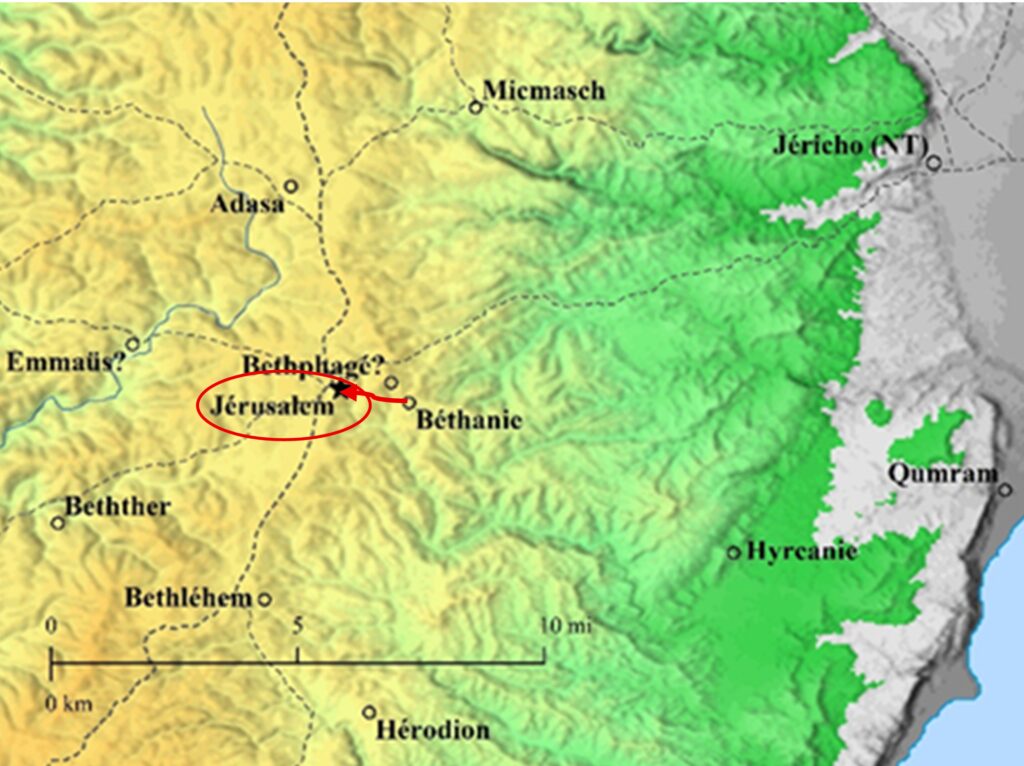
Map of Bethany and Jerusalem
Bar chart: Sunday

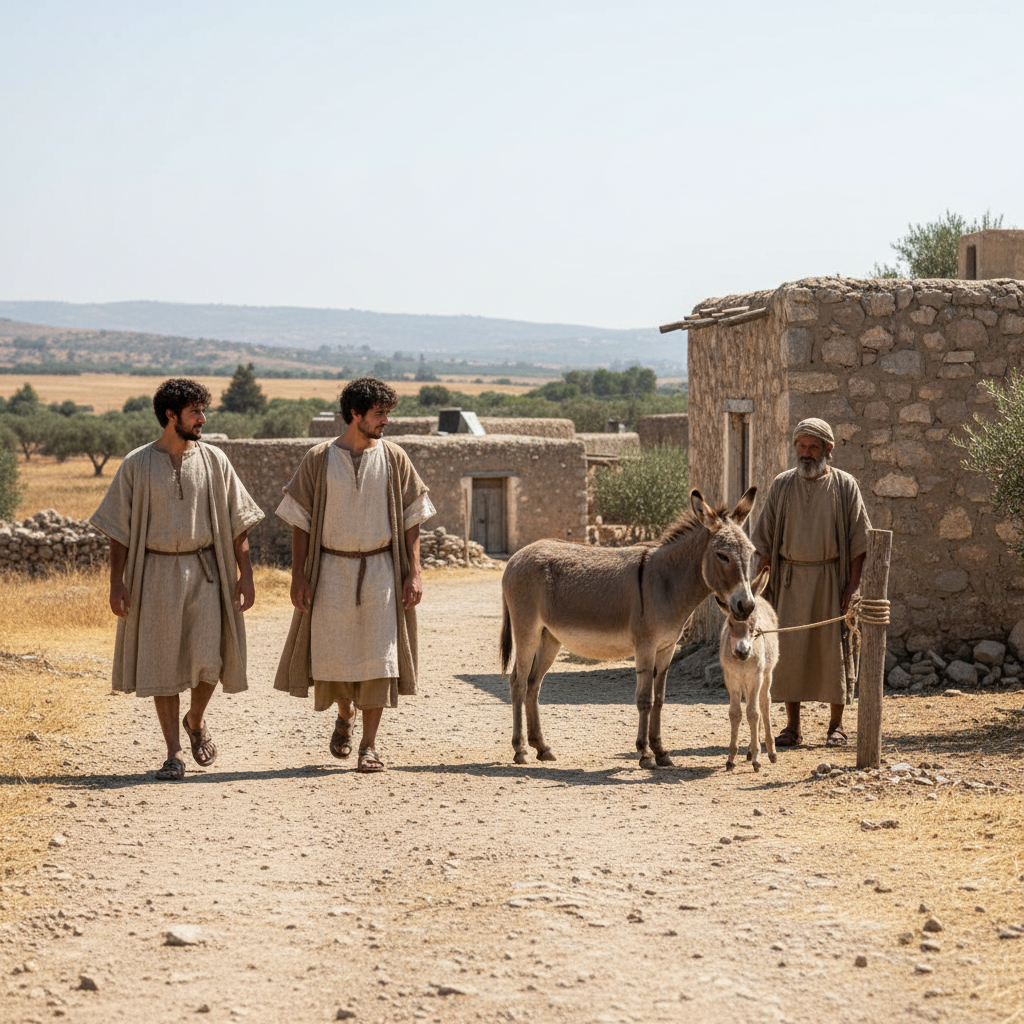
Jesus instructs two disciples to find a colt at Bethphage.

Comments

The village of Bethphage, located on the eastern slope of the , lay exactly on the road linking Bethany to Jerusalem. Mark and Luke, moreover, associate its name with that of Bethany to emphasise their immediate proximity.

At that time, the was not yet a particularly well-known place, but it naturally overlooked this pilgrim route. The Messiah Jesus and his disciples had made their camp near Bethany; on leaving it for Jerusalem, they were bound to pass close to Bethphage.

The name of this locality means “house of ”, which suggests that the mentioned later by Matthew and Mark (PER282) was probably located in this area. When the group reaches the outskirts of the village, the stop has only one purpose: the search for a colt.

The Messiah Jesus knows that he must enter Jerusalem seated on the foal of a donkey, thereby knowingly fulfilling the prophecy of Zechariah 9.9 announcing a humble and peaceful king. Matthew, true to his way of writing, explicitly stresses this prophetic link.

The Messiah Jesus then sends two of his disciples to fetch the colt and its mother. He gives them precise instructions: on entering the village, they will find the animals tied up; if anyone questions them, they are simply to answer that “the Lord has need of them”.

The Evangelists thus show the sovereignty of Jesus, who knows in advance the situation, the presence of the animals and even the reaction of their owners. These agree immediately when the disciples give the requested explanation. The episode highlights the unhesitating obedience of the two disciples, the quiet authority of the Master over the course of events, and the willing and public fulfilment of a long-awaited prophecy.