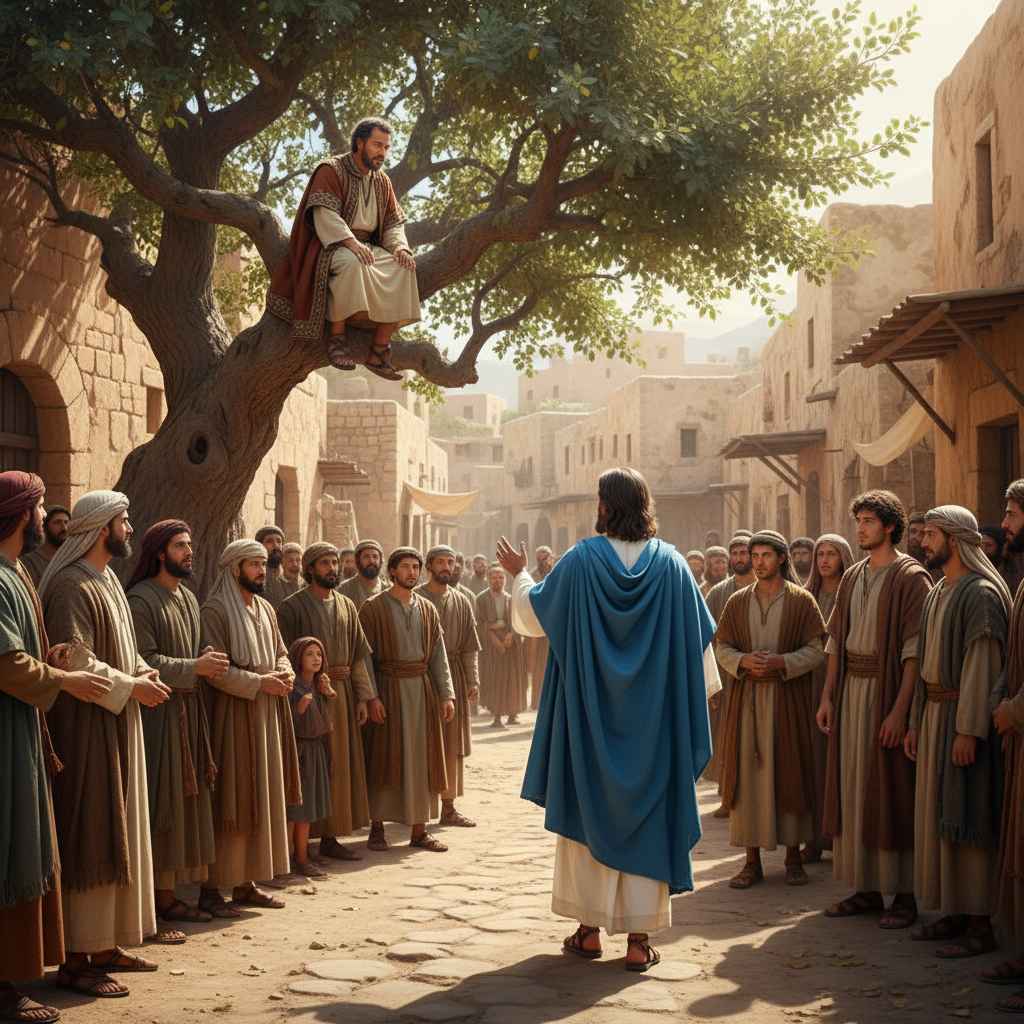
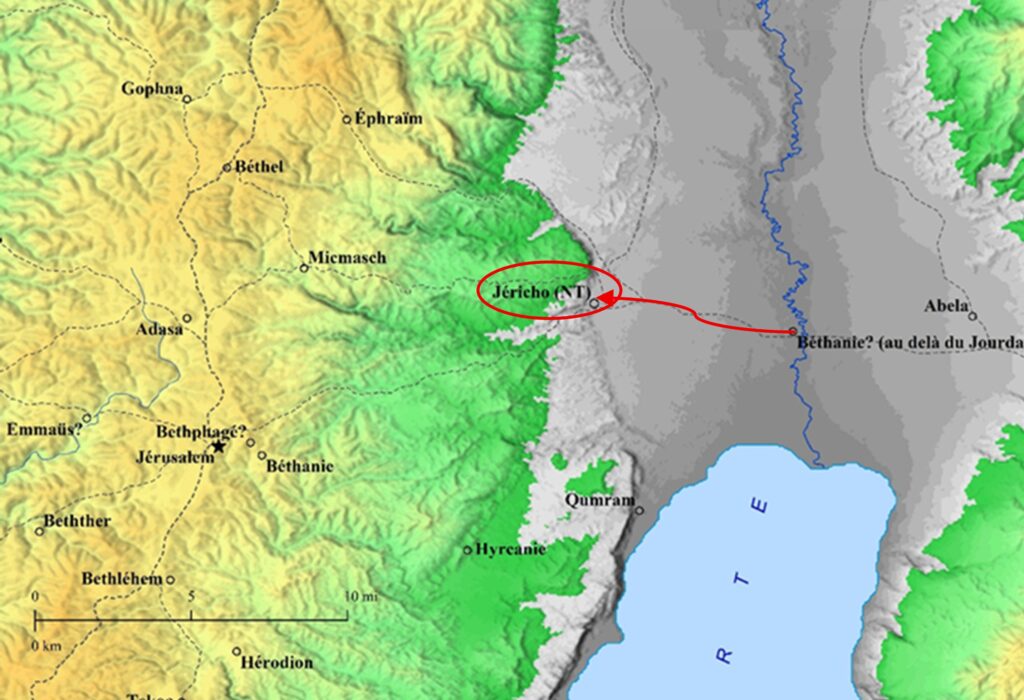
On this journey to Jerusalem in early AD 33, the Messiah Jesus, accompanied by his disciples and close companions, arrives in Jericho shortly before February–March. This stage, recounted by Luke, precedes the resurrection of Lazarus at Bethany at the home of . The atmosphere in Jericho is lively, as the healing of the blind man Bartimaeus shows. This journey takes place before the Passover of 1 April AD 33, for the Messiah Jesus still has to raise Lazarus and then stay at Ephraim.
PER271
Zacchaeus wants to see the Messiah Jesus
The article explores the story of Zacchaeus in Jericho, who, wanting to see Jesus, climbs a sycamore tree. Jesus notices Zacchaeus and stays at his house, embodying his mission of redemption. This account fits within the period between Hanukkah and Passover, including key events such as the miracle of Lazarus. The article presents an exegetical and theological analysis, highlighting the universal dimension of Jesus’ message.
6 min
Zacchaeus
Jesus
Jericho
salvation
Luke 19
3 verses
2 books
Resources
You can consult:
Biblical texts
Matthew
Matthew (King James Version) not cited in the book
Mark
Mark (King James Version) not cited in the book
Luke
Luke 19.1-10 (King James Version)
And Jesus entered and passed through Jericho.
And, behold, there was a man named Zacchæus, which was the chief among the publicans, and he was rich.
And he sought to see Jesus who he was; and could not for the press, because he was little of stature.
And he ran before, and climbed up into a sycomore tree to see him: for he was to pass that way.
And when Jesus came to the place, he looked up, and saw him, and said unto him, Zacchæus, make haste, and come down; for to day I must abide at thy house.
And he made haste, and came down, and received him joyfully.
And when they saw it, they all murmured, saying, That he was gone to be guest with a man that is a sinner.
And Zacchæus stood, and said unto the Lord; Behold, Lord, the half of my goods I give to the poor; and if I have taken any thing from any man by false accusation, I restore him fourfold.
And Jesus said unto him, This day is salvation come to this house, forsomuch as he also is a son of Abraham.
For the Son of man is come to seek and to save that which was lost.
King James Version (1769), domaine public — texte : eBible.org
John
John (King James Version) not cited in the book
Technical details

Location: City of Jericho
Date: February AD 33
Method: We follow Luke
Note on the method: Luke is the only one to record this story of Zacchaeus
A man of small stature uses a radical means to see Jesus despite the crowd.
Chronology
Comments
Luke stresses precisely that the Messiah Jesus, accompanied by his disciples, passes through Jericho (Luke 19.1. This journey is part of the route leading him to Jerusalem, at the beginning of AD 33. The purpose of this journey is to go to the home of , where Lazarus has just died.
The atmosphere is lively: many people are outside, and the episode of the healing of Bartimaeus, the blind man who wore his cloak (Mark 10.50), shows that we are in February or March. With the severe cold of January past, the scene probably takes place in February or at the very beginning of March.
This is not the Passover pilgrimage, which will take place on 1st April AD 33. Indeed, before that event, the Messiah Jesus must raise Lazarus, and then he will go away for a time to Ephraim, in Samaria.
The account of Luke 19.1-10 takes place in Jericho, a prosperous and strategic city on the road leading to Jerusalem, and Luke places this episode just before the messianic entry to show how salvation manifests itself concretely before the passion.
Zacchaeus, chief of the tax collectors and a rich man, is presented as a socially despised figure, regarded as a collaborator with the , a public sinner and an unclean man, and his small stature, mentioned by Luke, symbolizes both his physical inability to see Jesus and his social and moral smallness.
Yet he actively seeks to see who Jesus is, and his running, along with his act of climbing a sycamore, reveal an inner thirst and an unexpected humility for a man of his rank. The Messiah Jesus, looking up at him, reverses the dynamic: it is no longer Zacchaeus who seeks Jesus, but Jesus who sees him, calls him by name and declares that he must stay at his house, a “must” that expresses a divine necessity and shows that the encounter is not chance but an act willed for salvation.
Zacchaeus’ joyful welcome manifests the presence of salvation, and his immediate response, giving half of his goods to the poor and restoring four times as much to those he has wronged, goes far beyond the requirements of the Law and shows that his conversion is authentic, concrete and social.
Meanwhile, the crowd murmurs on seeing the Messiah Jesus enter a sinner’s house, revealing its incomprehension of the logic of the Kingdom and contrasting with the gaze of the Messiah Jesus, who does not judge but restores.
The Messiah Jesus concludes by proclaiming that salvation has come to Zacchaeus’ house and by affirming that he too is a son of Abraham, thus reinstating an outcast into the covenant people, before summing up his mission by declaring that the Son of Man came to seek and to save what was lost.
This passage highlights that grace precedes conversion, that salvation comes through a personal relationship with the Messiah Jesus, that it concretely transforms life and behavior, that the Messiah Jesus overturns social norms by going to the outcasts, and that joy always accompanies the breaking in of salvation.
Finally, it reminds us that no one is too far away to be reached, that conversion involves reparation and generosity, and that one must choose between the gaze that murmurs and the one that calls by name.