

In Luke's account, we find a succession of teachings addressing various themes, often presented in the form of . It is difficult to claim that Luke follows a strict chronology; rather, it appears that he arranges the teachings according to criteria that make the overall understanding of his text easier.
In this regard, it is very likely that the author chose to group eleven , even though they were spoken at different times and in different places. This editorial approach allows Luke to present the teachings of the Messiah Jesus thematically, giving priority to the clarity of the message over faithfulness to the chronological order of events.
The events reported here by Luke take place in Jerusalem, shortly before the , celebrated on December 15 of the year AD 32. However, it is important to stress that this discourse could belong at different times and in various places, since nothing suggests that Luke respects a strict chronological order. It is therefore probable that he chose this precise moment in the account to gather several major teachings, allowing himself to omit certain contextual details in order to offer a more concise and structured narrative.
This theme is developed in the paragraph entitled: . It is relevant to consider Luke's purpose when studying these chapters.
L’
Read the study on : PAR000 : The parables
We know that the Messiah Jesus had already addressed this theme during the Sermon on the Mount, which took place near Capernaum in Galilee, and which we have dated: After April 6, AD 31. Luke 14.34 appears as a repetition of this teaching. Our analyses suggest a repetition and show that Luke does not follow a strict chronology in his account.
The wording of Luke 14.34-35 differs from that of Matthew 5.13.
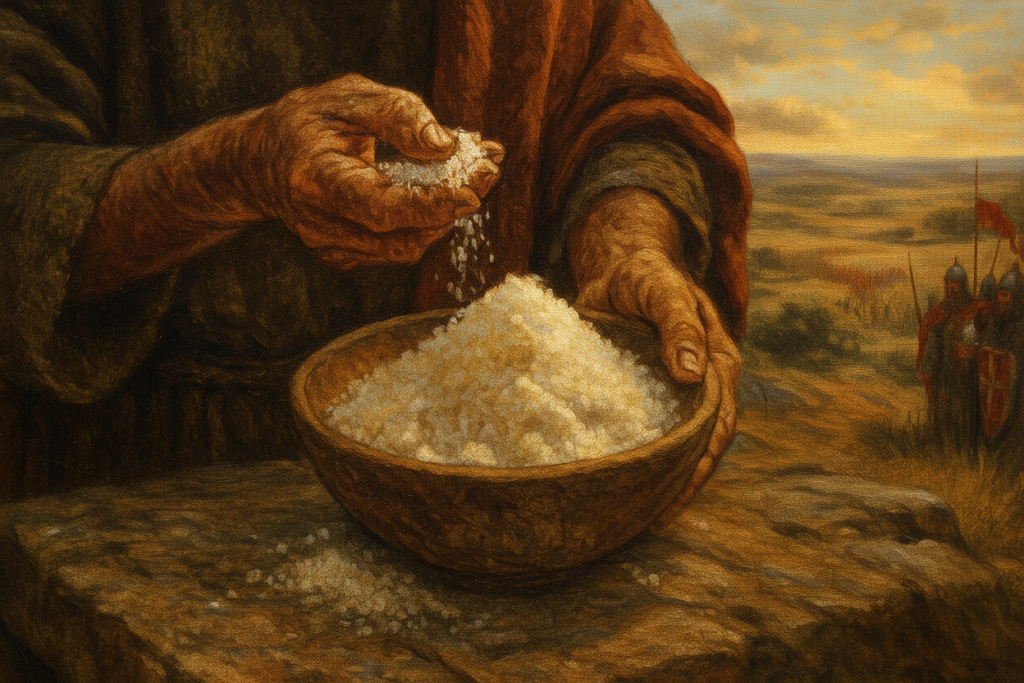
This passage closes a series of teachings on the cost of being a disciple and forms a striking conclusion through its brevity and depth. The Messiah Jesus uses the metaphor of salt, at once familiar and carrying significant spiritual weight.
Analysis of the text: Luke 14.34-35
“Salt is a good thing…”
In the ancient world, salt symbolized: purification (it disinfects), preservation (it keeps food), flavour (it gives taste).
The Messiah Jesus here acknowledges the intrinsic value of salt, just as that of the genuine disciple, committed and transforming.
“…but if salt loses its flavour…”
Paradox: chemically, pure salt does not lose its flavour, but in antiquity salt could be mixed with impurities and become useless.
Spiritual meaning: a disciple who loses his fervour, his integrity, or his witness becomes like bland salt, present but without impact.
“It is fit neither for the soil nor for the manure pile…”
Radical exclusion: this salt is no longer useful for any purpose, neither to fertilize nor to disinfect.
This rejection is therefore the consequence of total spiritual uselessness; it is a severe warning.
“He who has ears to hear, let him hear.”
Prophetic formula: an invitation to active listening and to putting it into practice.
This marks an existential urgency: the listener is faced with a choice, to keep his “flavour” or to become obsolete.
Spiritual and theological significance
Usefulness depends on identity: the disciple is not called to a lukewarm or neutral life. He is “salt”, that is, an agent of transformation.
Preserving fervour: to lose one's flavour is to live out one's faith as a formality or a habit, without power. It is also to accept principles that are not in keeping with the teaching of the Messiah Jesus.
A call to authenticity: a total and sincere commitment is the only acceptable “taste” in the Kingdom.
Comparison between Luke 14.34-35 and Matthew 5.13 in the context of a repetition
These two verses use the image of salt to speak of the role and identity of the disciple. But each does so in a different context, with marked theological nuances.
Common points
Image of salt: In both cases, salt represents the disciple or the community of believers.
Loss of flavour: The danger referred to is that of spiritual ineffectiveness, a faith without impact.
Consequence: The salt that has become useless is thrown out, a sign of rejection or of being set aside.
Key differences
Context: End of a discourse on the cost of becoming a disciple in Luke 14.34-35 and the beginning of the Sermon on the Mount in Matthew 5.13
Tone: a severe warning in Luke: the lukewarm disciple becomes useless; a positive exhortation in Matthew: you are the salt of the earth
Consequence: total uselessness in Matthew, “Neither for the soil nor for the manure pile”, and social and spiritual rejection in Luke, “Trampled underfoot by men”.
Audience: those who want to follow Jesus but hesitate to commit fully in Luke, and disciples already committed, called to influence the world in Matthew.
It is good to remember this paradox: salt, by nature, cannot lose its flavour. It is only when it is altered by impurities that it becomes useless. In the same way, only a complete consecration to the Messiah Jesus allows us to preserve our spiritual authenticity. The influences of the world, comparable to these impurities, are what tarnish our impact and our calling.