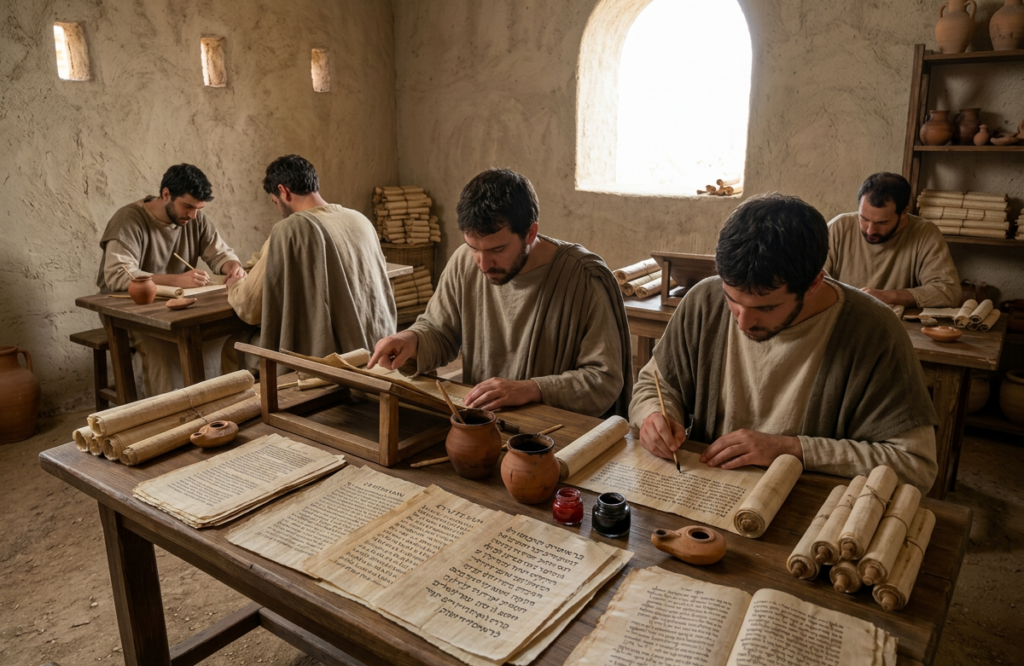
This article highlights the importance of the doctrine of God in Christian theology, addressing who God is and how he reveals himself to human beings. The knowledge of God comes from creation, from the moral conscience, and above all from Jesus Christ. This study encourages a life of worship and faith.
75 min
doctrineGodtheologyrevelationknowledge
95 verses
21 books
The doctrine of God holds a central place in all of Christian theology, because it touches on the most fundamental question: Who is God? Before addressing creation, salvation, the Church or the Christian life, we must begin with the One who is the source, the foundation and the goal of all things. The Bible opens its account with a simple and decisive statement: “In the beginning, God…” Genesis 1.1. This opening declaration establishes that God precedes everything, explains everything and gives meaning to everything.
Knowing God is not a purely intellectual or speculative pursuit. In Scripture, knowing God means entering into a relationship with him, acknowledging him as Lord, walking in his ways and answering his call. Jesus himself declares that eternal life consists in knowing the Father and the one he has sent John 17.3. Thus the doctrine of God is not a mere theoretical study: it is deeply bound up with faith, worship and the transformation of life.
This knowledge is possible only because God chooses to reveal himself. Human beings, limited and marked by sin, cannot reach God by their own efforts. But God makes himself known: through creation, which displays his power and wisdom Psalms 19.1-4; through the conscience, which bears witness to his law Romans 2.14-15; and above all through his Word, which reveals his character, his works and his purposes 2 Timothy 3.16. Revelation reaches its summit in Jesus Christ, “the image of the invisible God” Colossians 1.15, in whom God makes himself perfectly known.
Studying the doctrine of God therefore means bringing together three dimensions: the biblical dimension, which listens to what God says about himself; the theological dimension, which organizes and clarifies this revelation; and the practical dimension, which seeks to live in accord with this living God. All authentic theology leads to worship, for the more we discover who God is, the more we are led to love him, to fear him and to trust him. As Scripture says:
Hebrews 11.6 (King James Version) :
But without faith it is impossible to please him: for he that cometh to God must believe that he is, and that he is a rewarder of them that diligently seek him.
King James Version (1769), domaine public — texte : eBible.org
.
Thus, to begin a doctrinal study with the doctrine of God is not only logical: it is indispensable. It is laying the foundations on which everything else can be built.
I. The Existence of God
The existence of God is the starting point of all theology. Yet the Bible never tries to prove that God exists: it asserts it as a first self-evident truth. From the very first words of Scripture, God is presented as the initial and sovereign actor: “In the beginning, God created the heavens and the earth” Genesis 1.1. This statement is not argued for, but laid down as the foundation of all reality. Biblical faith therefore does not rest on human speculation, but on the revelation of a living God who makes himself known in history.
Scripture acknowledges, however, that some reject this truth. The psalmist declares:
Psalms 14.1 (King James Version) :
The fool hath said in his heart, There is no God. They are corrupt, they have done abominable works, there is none that doeth good.
King James Version (1769), domaine public — texte : eBible.org
This rejection is not presented as a rational conclusion, but as a moral attitude: a refusal to acknowledge God despite the witness he gives of himself. For God does not leave humanity without light. Creation itself proclaims his existence: “The heavens declare the glory of God, and the sky above proclaims his handiwork” Psalms 19.1. Paul affirms that God’s invisible attributes:
Romans 1.19-20 (King James Version) :
Because that which may be known of God is manifest in them; for God hath shewed it unto them.For the invisible things of him from the creation of the world are clearly seen, being understood by the things that are made, even his eternal power and Godhead; so that they are without excuse:
King James Version (1769), domaine public — texte : eBible.org
Nature, in its order, its beauty and its complexity, bears witness to a Creator.
God also reveals himself in the human conscience. Even without knowing the written law, people carry within them a moral knowledge that attests to the existence of a divine lawgiver. Paul writes that “Gentiles, who do not have the law, by nature do what the law requires,” showing that “the work of the law is written on their hearts” Romans 2.14-15. This moral conscience, though darkened by sin, remains an inner sign of the reality of God.
Throughout history, many thinkers have put forward rational arguments to demonstrate the existence of God: the cosmological argument (every effect has a cause), the teleological argument (order implies design), the moral argument (the existence of objective values presupposes a transcendent source), or again the ontological argument. These approaches can enlighten the mind and open a path toward faith, but they do not replace divine revelation. They show that believing in God is not contrary to reason, but they cannot produce faith. As Scripture reminds us, “without faith it is impossible to please him” Hebrews 11.6.
Thus, the existence of God is at once affirmed by the Bible, manifested in creation, inscribed in the human conscience and accessible to reason. But above all it is received by faith, in response to the revelation that God gives of himself. Christian theology therefore begins by acknowledging that God exists, that he speaks, and that he makes himself known to those who seek him.
II. The Revelation of God
If God exists and if human beings are called to know him, this knowledge can come only from a divine initiative. The Bible clearly affirms that man, by his own abilities, cannot reach God: “No one comprehends the thoughts of God except the Spirit of God” 1 Corinthians 2.11. The doctrine of revelation is therefore essential: it explains how the invisible, and transcendent God makes himself known to limited creatures marked by sin.
1. General Revelation
God first reveals himself in a universal way, accessible to all human beings. This general revelation is manifested chiefly in two ways.
a) In creation.
Nature bears the imprint of its Creator. The psalmist declares: “The heavens declare the glory of God, and the sky above proclaims his handiwork” Psalms 19.1. Paul affirms that God’s invisible attributes “have been clearly perceived” since the creation of the world Romans 1.19-20. The order, beauty and complexity of the universe testify to a powerful, wise and personal God.
b) In the human conscience.
Even without knowing the written law, human beings possess a moral conscience that attests to the existence of a divine lawgiver. Paul writes that “the work of the law is written on their hearts” Romans 2.14-15. This inner light, though darkened by sin, remains a sign of God’s presence.
General revelation is enough to make man accountable before God, but it is not enough to save him. It shows that there is a God, but it reveals neither his name nor his plan of redemption.
2. Special Revelation
Because general revelation is insufficient to lead man to salvation, God has spoken in a more precise, more direct and more personal way. This special revelation is found in Scripture and in the history of salvation.
a) The written Word.
The Bible is God’s inspired revelation. “All Scripture is breathed out by God” 2 Timothy 3.16. It reveals God’s character, his works, his promises and his will. It is not merely a human testimony, but the Word of God conveyed by men led by the Spirit 2 Peter 1.21.
b) The names of God.
In Scripture, the names of God are not mere labels: they reveal his being. Whether he presents himself as , “I AM” Exodus 3.14, as Elohim, the mighty God, or as Father, he unveils aspects of his identity and of his relationship with his people.
c) The history of salvation.
God also reveals himself through his acts: the covenant with Abraham, the deliverance from Egypt, the faithfulness toward Israel, the prophets, and finally the coming of the Messiah. Biblical revelation is progressive: God makes himself known step by step, until the full light.
3. The Supreme Revelation in Jesus Christ
All of God’s revelation converges on one person: Jesus Christ. He is “the image of the invisible God” Colossians 1.15, “the radiance of the glory of God and the exact imprint of his nature” Hebrews 1.3. In Jesus, God no longer merely speaks: he makes himself visible, accessible, near. Jesus can say: “Whoever has seen me has seen the Father” John 14.9.
The revelation in Christ is perfect, complete and final. It shows that God is not only a powerful Creator, but a loving Father, a compassionate Savior and a Lord who calls us to fellowship.
III. The Attributes of God
The doctrine of the attributes of God seeks to describe what God is in himself, as he reveals himself in Scripture. The attributes are not parts of God, but aspects of his single and simple being. God is not composite: he is perfectly one. Yet, for our limited understanding, the Bible presents to us different traits of his character. These attributes are generally divided into two categories: the incommunicable attributes, which belong to God alone, and the communicable attributes, which God reflects in part in the human being created in his image.
1. The Incommunicable Attributes of God
These attributes underline God’s transcendence, what radically distinguishes him from creation.
a) Independence (aseity)
God exists by himself and needs nothing and no one. He says: “I am who I am” Exodus 3.14.
He is not sustained by creation; he is the one who sustains it Acts 17.24-25.
b) Immutability
God does not change in his being, his purposes or his promises.
“I am , I do not change” Malachi 3.6.
His plans stand firm Psalms 33.11.
c) Eternity
God has neither beginning nor end. He is “from everlasting to everlasting” Psalms 90.2.
He sees time in a single glance, without being limited by it.
d) Omnipresence
God is present everywhere, without being confused with creation.
“Where shall I flee from your Spirit?” Psalms 139.7-10.
e) Omniscience
God knows all things perfectly, past, present and future.
“You know when I sit down and when I rise up” Psalms 139.1-4.
f) Omnipotence
God can do all that he wills, in accordance with his nature.
“Nothing will be impossible with God” Luke 1.37.
g) Unity (divine simplicity)
God is one, without division or contradiction.
“ is one” Deuteronomy 6.4.
His attributes never oppose one another: his justice is always a loving justice, and his love is always a holy love.
2. The Communicable Attributes of God
These attributes express what God reflects in part in the human being, created in his image.
a) Holiness
God is wholly set apart from evil and perfectly pure.
“Holy, holy, holy is ” Isaiah 6.3.
His holiness is the basis of his call to sanctification.
God is love in his very being 1 John 4.8.
His love is fully manifested in Christ: “God so loved the world…” John 3.16.
c) Goodness
God does good to all his creatures.
“ is good to all” Psalms 145.9.
d) Justice
God always acts according to what is right.
“All his ways are justice” Deuteronomy 32.4.
e) Mercy and grace
God forgives, raises up and shows grace to those who turn to him.
“ is merciful and gracious” Psalms 103.8.
f) Truth
God is perfectly true, faithful and trustworthy.
“Your word is truth” John 17.17.
g) Faithfulness
God always fulfills what he promises.
“God is faithful, by whom you were called” 1 Corinthians 1.9.
h) Patience
God bears with the sin of men with great forbearance.
“He is patient toward you” 2 Peter 3.9.
i) Wisdom
God orders all things according to a perfect design.
“Oh, the depth of the wisdom of God!” Romans 11.33.
Conclusion
The attributes of God are not abstract concepts: they reveal who God is and how he acts. They nourish worship, inspire trust and guide the Christian life. The more we contemplate the perfections of God, the more we are transformed into his image.
IV. The Unity and Tri-unity of God
The Bible strongly affirms two fundamental truths concerning God: God is one, and God exists eternally in three distinct persons. These two affirmations do not contradict each other; they express the depth of the divine mystery as God has revealed it. The unity of God protects the Christian faith from all polytheism, while the tri-unity (or Trinity) reveals the richness of the divine life and the way God acts in the history of salvation.
1. The Unity of God
The unity of God lies at the heart of biblical revelation. Israel was to confess every day:
Deuteronomy 6.4 (King James Version) :
Hear, O Israel: The LORD our God is one LORD:aNoteteach: Heb. whet, or, sharpenbNotebondage: Heb. bondmen or, servants
King James Version (1769), domaine public — texte : eBible.org
This affirmation excludes any idea of several gods, of rival deities or of impersonal forces. God is unique, incomparable, without equal:
Isaiah 45.22 (King James Version) :
Look unto me, and be ye saved, all the ends of the earth: for I am God, and there is none else.
King James Version (1769), domaine public — texte : eBible.org
This unity is not only numerical; it also expresses divine simplicity. God is not composed of parts or layers: he is one in his being, one in his attributes, one in his purposes. His justice is never separated from his love, his power never separated from his wisdom. Everything in him is perfectly harmonious.
The unity of God grounds the unity of the faith and the exclusivity of worship. Because there is only one God, there is only one Lord worthy of receiving man’s praise, trust and obedience.
2. The Tri-unity of God
If God is one, Scripture also reveals that he exists eternally in three distinct persons: the Father, the Son and the Holy Spirit. This truth is not the product of a philosophical construction, but the result of God’s progressive revelation in history.
a) Biblical affirmation
The New Testament clearly presents the three divine persons acting together. At the baptism of Jesus, the Son is in the water, the Spirit descends upon him, and the voice of the Father is heard from heaven Matthew 3.16-17. Jesus commands his disciples to baptize “in the name of the Father and of the Son and of the Holy Spirit” Matthew 28.19: one name, three persons.
The Father is God 1 Peter 1.2, the Son is God John 1.1, the Spirit is God Acts 5.3-4, and yet there is only one God.
b) Distinction of the persons
The three persons are neither three modes of one God, nor three separate gods. They are distinct in their relationships:
The Father begets the Son
The Son is begotten of the Father
The Spirit proceeds from the Father (and is sent by the Son)
These distinctions do not divide God; they express the richness of his inner life.
c) Unity of essence and harmony of action
The three persons share the same divine nature, the same glory and the same will. They always act together, but in distinct roles:
The Father plans
The Son accomplishes
The Spirit applies
In salvation, for example:
The Father sends the Son John 3.16-17,
the Son gives his life John 10.17-18,
the Spirit regenerates and sanctifies Titus 3.5.
d) The importance of the Trinity for the Christian faith
The Trinity is not an abstract doctrine: it structures the whole Christian life.
In salvation: we are chosen by the Father, redeemed by the Son, renewed by the Spirit.
In prayer: we pray to the Father, through the Son, in the Spirit.
In love: the love between the Father and the Son is the source of Christian love.
In the Church: the unity of God grounds the unity of the people of God.
The Trinity is the beating heart of the Christian faith. It reveals that God is not an eternal solitude, but a perfect communion of love, into which he invites humanity to enter.
V. The Works of God
The doctrine of the works of God describes everything that God accomplishes outside himself. It reveals how the , perfect and immutable God acts in time, in creation and in the history of salvation. The works of God are not separate from his being: they express what he is. His power, his wisdom, his goodness and his faithfulness are displayed in everything he does. The Bible distinguishes mainly three great categories of divine works: creation, providence, and redemption.
1. The Work of Creation
The first great work of God is the creation of all things. The Bible affirms that God created the universe by his Word: “God said… and it was so” Genesis 1.3. Nothing existed before his creative act: “By the word of the heavens were made” Psalms 33.6. The New Testament confirms that the Father, the Son and the Spirit were all involved in creation: “All things were made through him” (the Word, the Son) John 1.3, and “the Spirit of God was hovering over the face of the waters” Genesis 1.2.
Creation manifests God’s glory, his wisdom and his power. It is not the fruit of chance, but the result of a sovereign design. God creates out of goodness, so that his creatures may share in his life and his joy. The human being, created in the image of God Genesis 1.26-27, occupies a special place: he is called to reflect the divine character and to exercise responsible dominion over creation.
2. Providence
After creating the world, God does not abandon it to itself. He continues to sustain it, to direct it and to bring it to fulfillment according to his plan. Providence designates the work by which God preserves, concurs with and governs all things.
a) Preservation
God maintains the existence of all that he has created. “He upholds the universe by the word of his power” Hebrews 1.3. Without his constant action, creation would return to nothingness.
b) Concurrence
God acts in and through the actions of his creatures, without ever violating their will. “It is God who works in you, both to will and to work” Philippians 2.13. Nothing happens outside his sovereignty.
c) Government
God directs history toward the fulfillment of his purposes. “ reigns” Psalms 93.1. He raises up and brings down nations, leads events and watches over his people. Even what seems chaotic or unjust is integrated into his perfect plan, as the story of Joseph shows: “You meant evil against me, but God meant it for good” Genesis 50.20.
Providence does not cancel human responsibility; it guarantees that nothing can thwart the purposes of God.
3. The Redemptive Works
God’s greatest work is that of redemption. Faced with sin and the fall of humanity, God did not abandon his creation. He set in motion an plan to save, restore and renew.
a) The covenant
From the first chapters of the Bible, God reveals himself as a covenant God. He promises a Savior Genesis 3.15, calls Abraham Genesis 12.1-3, and establishes a relationship of grace with his people. The covenant structures the whole history of salvation.
b) Election
God freely chooses a people to belong to him. “He chose us in him before the foundation of the world” Ephesians 1.4. Election is not an exclusive privilege, but a calling to reflect God and to be a light to the nations.
c) Redemption in Christ
At the center of history stands the work of the Son. Jesus Christ perfectly fulfills the Father’s will, gives his life as a ransom for many Mark 10.45, takes away the sin of the world John 1.29, and rises again to give eternal life. The cross and the resurrection are the heart of the redemptive work.
d) The work of the Holy Spirit
The Spirit applies to the believer what Christ has accomplished. He regenerates Titus 3.5, sanctifies 1 Corinthians 6.11, comforts John 14.26, and seals believers for the day of redemption Ephesians 1.13-14.
Redemption is not only individual: it extends to all creation, which waits to be set free from corruption Romans 8.19-21.
Conclusion
The works of God reveal a living, active, sovereign and compassionate God. From creation to the new creation, God acts with power and wisdom to accomplish his purpose: to make his glory known and to gather a people for himself. Contemplating his works nourishes faith, inspires trust and leads to worship.
VI. God and Man
The relationship between God and man lies at the heart of biblical revelation. God is not only the transcendent Creator: he is also the God who draws near, who speaks, who calls and who enters into covenant with humanity. Understanding this relationship is essential for grasping man’s vocation, the nature of sin and the dynamics of salvation. The doctrine of God does not remain abstract: it touches the human condition directly and sheds light on how man is called to live before God.
1. God as Lord
From the first pages of the Bible, God reveals himself as the sovereign Lord over all creation. He creates by his Word, gives order, blesses and entrusts man with a mission. Man is not autonomous: he is a dependent creature, called to live under God’s benevolent authority. The title “Lord” expresses this sovereignty. Scripture affirms:
Psalms 24.1 (King James Version) :
The earth is the LORD’s, and the fulness thereof; the world, and they that dwell therein.
King James Version (1769), domaine public — texte : eBible.org
Acknowledging God as Lord means accepting his Word, submitting to his will and walking in obedience. The refusal of this lordship lies at the heart of sin: man wants to be his own master, to define good and evil for himself Genesis 3.5-6. The restoration of the relationship with God therefore comes through the recognition of his sovereignty and through repentance.
2. God as Father
If God is Lord, he is also Father. This relational dimension is already present in the Old Testament, where God calls Israel “my son” Exodus 4.22, but it reaches its fullness in the New Testament. Jesus teaches his disciples to pray: “Our Father in heaven” Matthew 6.9. Through faith in Christ, believers become children of God:
John 1.12 (King James Version) :
But as many as received him, to them gave he power to become the sons of God, even to them that believe on his name:
King James Version (1769), domaine public — texte : eBible.org
The fatherhood of God expresses his love, his protection, his discipline and his closeness. It is not a mere symbolic concept: it describes a real relationship, founded on the spiritual adoption brought about by the Spirit Romans 8.15-16. God is not only the sovereign Master: he is the loving Father who takes care of his children.
3. Human Responsibility before God
Because God is Lord and Father, man is responsible before him. This responsibility is manifested in several ways:
Moral responsibility: man is called to reflect the character of God, to practice justice, truth and holiness.
Spiritual responsibility: man must answer God’s call, believe, repent and walk in faith.
Vocational responsibility: man is charged with tilling the earth, managing creation and living in relationship with others according to the divine will.
The Bible affirms that “we must all appear before the judgment seat of Christ” 2 Corinthians 5.10. Human life is therefore not without direction or without consequence: it is lived before God, under his gaze and for his glory.
4. The Knowledge of God as a Living Relationship
In the Bible, knowing God does not mean only knowing things about him. It is entering into a personal, living and transforming relationship. Jesus says:
John 17.3 (King James Version) :
And this is life eternal, that they might know thee the only true God, and Jesus Christ, whom thou hast sent.
King James Version (1769), domaine public — texte : eBible.org
This knowledge involves:
Faith, which welcomes God’s revelation;
Love, which answers divine love;
Obedience, which shows trust;
Communion, sustained by prayer, the Word and the Spirit.
The relationship between God and man is not static: it is meant to grow. God makes himself known progressively, and man is invited to walk with him, like Enoch Genesis 5.24, Abraham Genesis 17.1 or the disciples of Jesus.
Conclusion
God is not a distant concept: he is Lord, Father and Savior. Man, created in his image, is called to live in relationship with him, in faith, obedience and love. Understanding this relationship sheds light on the whole Christian life and prepares us to approach the following doctrines, notably those of sin, salvation and sanctification.
VII. A Short Summary of the Doctrine of God
The doctrine of God is the foundation of all Christian theology. The Bible presents God as the sovereign Creator, eternal and immutable, who exists by himself and who reveals himself to humanity. He makes himself known through creation Psalms 19.1, through the conscience Romans 2.14-15, through inspired Scripture 2 Timothy 3.16, and fully in Jesus Christ, the perfect image of the Father Colossians 1.15.
God is one Deuteronomy 6.4, yet he exists eternally in three persons: the Father, the Son and the Holy Spirit Matthew 28.19. His attributes reveal his greatness: he is almighty, all-knowing, holy, just, good, faithful and full of grace. His works manifest his character: he creates, sustains, governs and saves. Finally, God enters into relationship with man as Lord and as Father, calling each one to faith, obedience and communion with him John 17.3.
Knowing God is not only understanding truths: it is entering into a living relationship that transforms life and gives direction to all theology.
General Conclusion
The doctrine of God is the foundation of all Christian theology. As we journey through Scripture, we discover a living, personal, sovereign and loving God, who reveals himself, who acts and who calls humanity to enter into relationship with him. The study of his existence, his revelation, his attributes, his unity and his tri-unity, as well as his works and his relationship with man, leads us to a clearer and deeper vision of the One who stands at the center of all reality.
God is not an abstract concept or a philosophical idea: he is the God who speaks, who creates, who saves and who renews. He is the one God Deuteronomy 6.4, but also the Trinitarian God, Father, Son and Holy Spirit, acting in perfect harmony to accomplish his eternal purpose. He is the Creator of all things Genesis 1.1, the Sustainer of the universe Hebrews 1.3, and the Redeemer who, in Jesus Christ, fully manifests his love and his justice John 3.16.
This doctrine is not intended merely to inform the mind: it transforms life. To know God is to enter into a living relationship with him, to walk in faith, worship and obedience. It is to acknowledge his sovereignty, to receive his fatherly love, and to answer his call to holiness. As Jesus says, “this is eternal life, that they know you, the only true God, and Jesus Christ whom you have sent” John 17.3.
In conclusion, the doctrine of God is the gateway to all theology, but it is also its summit. The more we contemplate God as he reveals himself in Scripture, the more we are led to worship, trust and transformation. This study naturally prepares the transition to the following doctrines: the Word of God, creation, man, sin, salvation, the Church and the last things. Each of these doctrines finds its meaning and coherence in the knowledge of the living God.
Having contemplated who God is in his being, his attributes, his tri-unity and his works, it is natural to turn to the next question: how does this God make himself known?
For if God is living, personal and relational, then he speaks. The Bible does not present a silent or distant God, but a God who reveals himself, who communicates and who enters into dialogue with humanity.
The knowledge of God is possible only because he takes the initiative to make himself known. His Word is the means by which he reveals his character, his will and his purpose. It is also the foundation of faith, worship and obedience. As Scripture says: “All Scripture is breathed out by God” 2 Timothy 3.16, and “faith comes from hearing, and hearing through the word of Christ” Romans 10.17.
Thus, having studied the doctrine of God, it is essential to examine the doctrine of the Word of God, in order to understand how God reveals himself, how he speaks, and how his Word structures the whole life of the believer. This doctrine will then serve as a foundation for approaching creation, salvation, the Church and all of Christian theology.
A title, a person, a place, a reference (“Luke 15”)…
opens in a new window
Bible reference
INF010
Information note
INF010 - The unpronounceable name of God
YHWH, the unpronounceable name of God
The name of God, transcribed in French as YHWH, is considered unpronounceable because it consists of four Hebrew consonants: Yod (י), He (ה), Waw (ו) and He (ה).
Vowels are not written in Hebrew, which makes the exact pronunciation uncertain. This name appears about 6,800 times in the Hebrew Bible and is considered holy.
In accordance with the third commandment, which forbids taking the divine name in vain (Exodus 20.7), Jews avoid pronouncing it. Instead, they use other terms such as Adonai (my Lord) or Ha Elohim (the God). Some Bible translations also use the names Yahvé, Yahweh or Jehovah to represent the Tetragrammaton.
The Tetragrammaton would eventually be translated by the Greek word Kyrios, meaning Lord, which would in turn be replaced by ‘the Eternal’ in our Protestant Bibles.
The One God of the Jews, who is also the God of Christians, therefore has an unpronounceable name.
INF038
Information note
INF038 - YHWH
YHWH
The tetragrammaton YHWH is the proper name of God used in the Hebrew Bible. Here is some key information:
Meaning and origin
Name of God:YHWH is regarded as the most sacred name of God in Judaism. It is often rendered "the LORD" or "Jehovah" in English.
Origin: The term "tetragrammaton" means "four letters" in Greek, referring to the four Hebrew letters יהוה (yod, heh, waw, heh).
Pronunciation
Unknown: The exact pronunciation of the tetragrammaton is unknown because, in Jewish tradition, it was forbidden to pronounce this name in order to avoid profaning it.
Substitutes: In its place, substitutes such as "Adonai" (Lord) or "HaShem" (The Name) are used.
Usage
Sacred text:The tetragrammaton appears frequently in the Torah and other writings of the Hebrew Bible. Ritual and prayers: In prayers and rituals, Jews generally use "Adonai" to replace YHWH when they read the sacred texts aloud.
Theological importance
Monotheism:YHWH underscores the uniqueness and exclusivity of God in the Jewish faith. Divine relationship:It expresses the personal relationship between God and the people of Israel, marking a divine revelation and a covenant.
The tetragrammaton is therefore a central and sacred element in Jewish theology and religious practice.