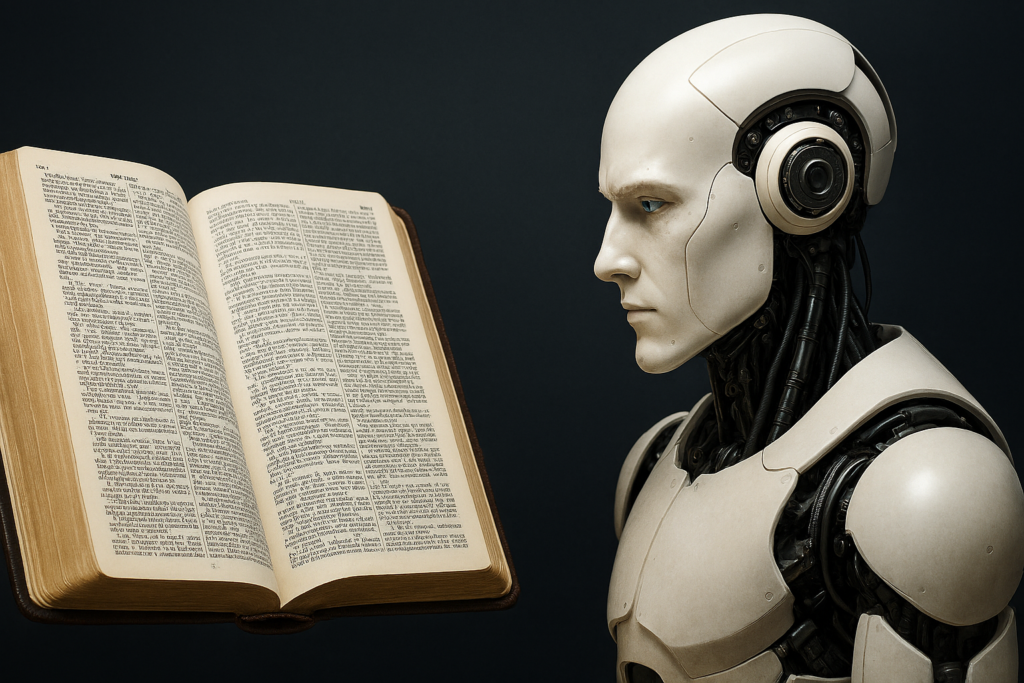
The article discusses how artificial intelligence could transform Bible translation, while highlighting the linguistic and cultural challenges of translating ancient texts. It also looks at the Segond 21 translation, which reconciles faithfulness with modern language.
15 min
Artificial IntelligenceBible TranslationSegond 21
1 verse
1 book
AI (Artificial Intelligence) is enough to frighten, so great has its influence become in our day (December 2025). This explosion makes possible literary feats, developments worthy of experts, magnificent presentations and stunning photos. It seems that this is only the beginning of the integration of AI into the work of men.
What will interest us is the influence of AI on a translation of the Hebrew and Greek texts of our Bibles. Can we imagine the perfect translation that would win unanimous approval in all the Churches, a transcription without human betrayal, just a literal correspondence to the original writings?
Can we hope for a synthesis of all the translations of the biblical texts, and then a transposition into any language, thus ignoring the convictions of human translators?
I. The Difficulty of Translating an Ancient Text
Translating an ancient text like the Bible is a complex, demanding and deeply delicate task. Here are the main difficulties translators face, especially when it comes to making the text accessible without religious jargon:
1. Ancient Languages and Lost Nuances
The Bible was written in Hebrew, Aramaic and ancient Greek, languages very different from modern French. Some words have no direct equivalent: for example, the Hebrew word "nephesh" can mean "soul," "life," or "person," depending on the context.
Verbs, tenses, and poetic or prophetic constructions are often impossible to translate literally.
2. Symbols and Cultural Images
The biblical texts are full of symbols rooted in ancient culture: the , oil, the desert, trumpets, and so on. These images spoke to a first-century reader, but may seem obscure or distorted to a contemporary reader.
Translating is often interpreting: should the symbol be kept as it is, or transposed into a more current image?
3. Evolution in the Meaning of Words
Some words have changed meaning over time. Example: the word "charity" in older translations means "love," but today it evokes help for the poor.
An overly literal translation can mislead or create misinterpretations.
4. Theological and Doctrinal Choices
Every translation involves choices of interpretation. Example: should logos be translated as "word," "reason," or "discourse"?
Translators must balance faithfulness to the text with clarity for the reader, without imposing a dogmatic reading.
5. Style and Orality
The biblical texts often have an oral structure: repetitions, rhythms, memorable formulas. A good translation must respect this musicality while remaining fluent and understandable.
This is particularly important for prophetic or poetic passages.
Synthesis
Translating the Bible is not simply converting words from one language to another. It is conveying a meaning, an emotion, a vision, while respecting the original text and making it alive for today's reader. It takes rigor, sensitivity, and sometimes creativity.
II. The S21 Translation
The translation of the (S21) took about 12 years of work.
Details on the Duration of the Project
The project was launched in 1995 by the Geneva Bible Society, with the aim of offering a translation faithful to the original texts but expressed in modern language.
A first partial version (the New Testament) appeared in 2004 under the name Nouvelle Segond 21.
The complete translation, including the Old Testament, was published in 2007.
In all, 12 years of work were needed to revise the Hebrew, Aramaic and Greek texts, compare the available manuscripts (the Leningrad for the Old Testament, and for the New Testament), and produce a version accessible to the contemporary reader.
Why So Much Time?
Faithfulness to the original texts: the translators wanted to stay close to the ancient manuscripts, avoiding hypothetical reconstructions.
Modern language: the aim was to make the Bible understandable for the twenty-first-century reader, without sacrificing accuracy.
Collective work: a team of translators and revisers worked continuously to harmonize the style and check every passage.
The Segond 21, "The original, in today's words," is the fruit of 12 years of work, between faithfulness and modernity.
III. Could AI Have Done This Work?
We have just glimpsed the complexity and depth of the work behind the Segond 21. If we ask whether an AI could have done this work, we need to distinguish several dimensions:
What an AI Could Do
Rapid linguistic analysis: an AI can compare thousands of manuscripts, spot textual variants, and propose correspondences between Hebrew, Aramaic, Greek and French in a matter of seconds.
Translation proposals: it can generate literal or dynamic translations, depending on the rules it is given.
Stylistic uniformity: AI excels at harmonizing vocabulary and syntax to ensure consistency throughout the text.
Modern accessibility: it can adapt the language to the contemporary reader, offering clear and fluent rewordings.
What Remains Difficult for an AI
Theological and hermeneutical choices: translating the Bible is not only a linguistic operation, it is also an interpretation. For example, deciding between a literal translation and a more dynamic one involves a theological and pastoral vision.
Cultural and symbolic nuances: an AI may miss the symbolic or spiritual depth that human translators seek to preserve.
Collective work and debate: the Segond 21 is the fruit of discussions, compromises and human decisions. An AI can make proposals, but it does not debate, nor does it take into account the ecclesial and communal dimension.
Responsibility and authority: a Bible translation commits an institution and people who take responsibility for the faithfulness and reception of the text. An AI cannot bear this responsibility.
Comparison with the 12 Years of Human Work
Duration: an AI could have sped up certain stages (comparison of manuscripts, stylistic harmonization).
Quality: without human supervision, the result would risk being too mechanical or lacking in spiritual depth.
Present reality: today, Bible translation projects already use computer tools and sometimes AI to assist, but never to replace human discernment.
In summary: yes, an AI could have reduced the technical time, but no, it could not have replaced the human work of discernment, debate and spiritual responsibility. The Segond 21 is as much a work of translation as a work of faith and community.
IV. Let's Take a Concrete Example
Let us make a small concrete comparison to show the difference between a raw translation generated by an AI and the Segond 21. It illustrates well why 12 years of human work were necessary.
"In the beginning was the Word, and the Word was with God, and God was the Word."
Faithful word for word, but a little stiff. The last segment "God was the Word" can seem ambiguous or awkward in modern French.
No stylistic choice, just a mechanical transposition.
Segond 21 Version
"In the beginning, the Word already existed. The Word was with God, and the Word was God."
Smoother and more understandable for a contemporary reader. The choice "already existed" makes the idea clearer than the simple "was." The last segment "the Word was God" avoids ambiguity and keeps the theological force.
Analysis
AI: fast, literal, useful for a first linguistic approach.
HI (Humans) (Segond 21): add clarity, stylistic consistency, and theological discernment.
Using artificial intelligence for translation provides a raw basis, faithful to the source text but often lacking nuance or style. This first step, though quick and useful for an initial linguistic analysis, sometimes lacks clarity or accessibility for a contemporary reader.
This is where human intervention takes on its full meaning. Through the work of refinement, the human brings clarity, stylistic consistency and discernment, making the text alive and understandable. The example of the Segond 21 version illustrates how human choices of wording avoid ambiguities and convey the full force of the original content, where the machine is content with a mechanical transposition.
V. Is a Beautiful Text Enough?
Here is an essential question. Translating the Bible is not only a literary or linguistic exercise: it involves a spiritual dimension that many consider indispensable.
The Beautiful Text: Necessary but Not Sufficient
A fluent, harmonious and understandable text is crucial so that readers can access the message.
Human translators (as with the Segond 21) have sought to make the Word alive and clear for the modern reader.
But an elegant style does not guarantee that the deep and spiritual meaning is conveyed.
The Spiritual Dimension
Christian tradition: Bible translation is often understood as a ministry, in which the Holy Spirit accompanies and enlightens the translators.
Discernment: some translation decisions are not purely technical. They involve a theological, pastoral and spiritual understanding.
Community: translators work in dialogue with the Church and its readers, which places their work in a shared spiritual dynamic.
The Balance
AI or technique alone: can produce a correct text, but without spiritual discernment.
Human work guided by the Spirit: seeks to convey not only the words, but also the living Word that nourishes faith.
That is why many insist that Bible translation is both an intellectual work and a spiritual act.
In summary: a beautiful text is a necessary condition, but Bible translation is also an act of faith. Translators are not content to make words accessible; they seek to convey the Word in all its spiritual depth, letting themselves be guided by the Holy Spirit.
VI. Would AI Be a Good Servant in This Work?
Now we come to a crucial question: can artificial intelligence be an effective tool in the work of Bible translation?
The Strengths of AI as a Tool
Time savings: AI can quickly compare manuscripts, spot textual variants and propose linguistic correspondences.
Linguistic assistance: it can generate raw translations, suggest synonyms, harmonize style and check terminological consistency.
Accessibility: it can adapt the language for different audiences (young people, non-specialist readers, etc.), by creating simplified or contextualized versions.
Teaching support: AI can produce diagrams, timelines, concept maps or comparisons to help with teaching.
The Unavoidable Limits
Spiritual dimension: translating the Bible is not only transposing words, it is conveying a living Word. AI cannot discern, nor be guided by the Holy Spirit.
Theological choices: some translation decisions involve a spiritual and ecclesial interpretation that AI cannot assume.
Community responsibility: a translation commits an institution and people who bear responsibility before the readers and the Church.
Symbolic nuances: AI may miss the depth of biblical images and their spiritual resonance in the tradition.
Conclusion
Yes, AI can be an effective tool of technical and educational assistance: it speeds up, compares, harmonizes, proposes.
No, it cannot replace the spiritual and communal human work: discernment, prayer and the influence of the Holy Spirit remain essential.
In short, AI can be a precious ally for translators and teachers, but never a substitute. It is an instrument, not an authority.
VII. Are There Currently Any Translation Initiatives Based on Artificial Intelligence?
There are several initiatives today exploring the use of artificial intelligence for Bible translation, but they remain assistance tools and not substitutes for the spiritual and communal work.
Current Initiatives
Scripture Forge (2024): a project launched by Wycliffe and its partners, which uses AI to assist translators in nearly 500 projects around the world. The tool helps to propose translation drafts, compare variants and speed up the work, but always under human supervision.
Wycliffe Associates – AI Working Group: this missionary organization has created a dedicated team to explore how AI can support mother-tongue translators. Their goal is to improve the quality and consistency of translations while respecting ethical and doctrinal guidelines.
HelloBible (2024): an application currently being launched that uses AI to facilitate Bible study. It stresses that AI is a complementary tool and not a substitute for the Holy Spirit, aiming to enrich the understanding of the sacred texts.
Conclusion
AI is already used in Bible translation, but as an assistance tool. It speeds up and eases the work, especially in minority languages, but it does not replace the spiritual, theological and communal role of human translators.
As of today (December 9, 2025), neither the Geneva Bible Society (SBG) nor the French Bible Society (SBF) has announced Bible translation projects based directly on artificial intelligence. They use digital tools (applications, electronic editions, study platforms), but not AI for the translation itself.
Geneva Bible Society (SBG)
The SBG is the publisher of the Segond 21, the fruit of 12 years of human work (1995–2007).
Today, it offers Bible study applications (Segond 21, , etc.) with modern features: advanced search, highlighting, personal notes, reading plans.
These tools are digital, but they do not rely on AI for the translation. The goal remains to make the Bible accessible to a wide audience, with a deliberately low price and mass distribution.
French Bible Society (SBF)
The SBF is a member of the French Bible Alliance, itself linked to the United Bible Societies.
Their mission is to distribute the Bible in French and in minority languages, often in partnership with other Bible societies.
Current projects emphasize distribution, digital publishing and accessibility, but there is no official communication on the use of AI for translation.
However, the United Bible Societies are already exploring AI as an assistance tool in certain worldwide projects, notably to speed up translation into under-resourced languages.
In summary
SBG and SBF: no AI projects for translation, but a strong investment in digital tools (applications, electronic distribution).
Worldwide level: some related organizations (Wycliffe, UBS) are experimenting with AI as an assistance tool, never as a substitute for human and spiritual discernment.
Current position: AI is seen as technical support, not as a main player in Bible translation.
The major Bible societies remain cautious. They adopt digital technology for accessibility, but keep translation as a spiritual and communal work.
We note today (December 9, 2025) that artificial intelligence (AI) has become accessible to an ever wider public. In a short time, it has established itself as an indispensable tool in many fields. Its progress seems so extraordinary that it is hard to imagine its limits.
From then on, envisaging a translation of the biblical texts carried out by AI is only a step... which has not yet been taken. The major Bible societies show a certain caution, even reserve. It is indeed hard to accept that God's message for humanity should be translated and adapted by a machine. This reserve is perhaps not only that of the institutions, but also that of Christian readers, deeply attached to translations that come from human work. Being able to know the translators, the teams who collaborated, is a reassuring element for many. Even imagining the best translation ever produced by AI, it is likely that it would not be fully received by the general public.
We think that human intelligence (HI) still has good days ahead of it in this field. It seems unimaginable that a machine could be inspired by the Holy Spirit, whereas the men who take part in these projects can be. AI will no doubt remain a precious help, but it could never become the master translator.
2 Timothy 3.16 (King James Version) :
All scripture is given by inspiration of God, and is profitable for doctrine, for reproof, for correction, for instruction in righteousness:
King James Version (1769), domaine public — texte : eBible.org
A title, a person, a place, a reference (“Luke 15”)…
opens in a new window
Bible reference
INF071
Information note
INF071 - Artificial Intelligence (AI)
Artificial Intelligence (AI)
Artificial intelligence (AI) is a field of computer science that aims to create systems capable of performing tasks that normally require human intelligence. Here are some key aspects of AI:
Definition and Goals
Definition: AI is the simulation of human intelligence processes by machines, especially computer systems. Goals: It aims to create machines capable of reasoning, learning, perceiving and acting autonomously.
Types of AI
Weak AI (or narrow AI): Designed to perform a specific task, such as virtual assistants (e.g. Siri, Alexa). Strong AI (or general AI): Hypothetically capable of understanding, learning and performing any intellectual task that a human can do (still in the research and development phase).
Techniques Used
Machine Learning:Machines learn from data to improve their performance over time. Neural Networks:Models inspired by the human brain, used for complex tasks such as image recognition and natural language understanding. Natural Language Processing (NLP): Enables machines to understand and respond to human language in a natural way.
Applications Virtual Assistants: Siri, Alexa, Microsoft Copilot. Image Recognition: Used in medicine to analyze X-rays. Autonomous Vehicles: Cars able to drive without human intervention.
Challenges and Ethics
Technical Challenges: These include creating more efficient algorithms and managing large amounts of data. Ethics: This involves questions about transparency, privacy, and algorithmic bias.
AI is a constantly evolving field that is transforming many aspects of our daily lives and opening up new prospects for the future.
INF070
Information note
INF070 - HelloBible
HelloBible
HelloBible is an innovative platform that uses artificial intelligence to help users explore the Bible in a personalized way. Here are some key points:
Personalized Conversations: Users can ask questions about the Bible and receive personalized answers based on the teachings of Jesus. Help with Prayer: HelloBible offers prayer topics and words of Jesus Christ to help users in their spiritual life. Data Security: The personal data collected by the AI is stored securely and is not passed on. Accessibility: The app will be available in several languages, including French, and will be accessible free of charge with a voluntary payment system.
HelloBible is an initiative of the team of Eric Célérier, pastor and co-founder of several high-impact ministries. The app is designed to offer easy, personalized access to the Word of God.
This site is a relevant example to illustrate present and future issues. Spiritual assistance is no longer provided directly by a person, but by a machine which, although under the responsibility of an individual, raises important questions. Despite its avant-garde nature, many people (more than 700,000 at the time of writing this article, 12/12/2024). connect to this site, thus demonstrating its appeal.
As a further example, though without going as far, we can mention Logos Bible Software, which we use daily and which has recently integrated artificial intelligence (AI) into its search modules.
INF080
Information note
INF080 - The 1996 Nouvelle Édition de Genève
The 1996 Nouvelle Édition de Genève
The Nouvelle Édition de Genève (NEG) 1996 is a revised version of Louis Segond's translation, intended to modernise and refine the previous 1979 version. Here are some key points about this revision:
Background and aims
Linguistic modernisation: The 1996 revision aims to update the language to make it more understandable and fluent for contemporary readers. Incorporating new discoveries: It incorporates discoveries and advances in textual criticism made since the publication of the previous version in 1979. Improved clarity: One of the main aims was to improve the text's clarity and readability by simplifying certain expressions and using more common terms.
Main features
Faithfulness to the original texts: The NEG 1996 draws on the most reliable ancient manuscripts to ensure an accurate and faithful translation. Linguistic revision and updating: The language was revised to reflect modern French usage better while preserving the richness and depth of the biblical text. Notes and references: The version often includes explanatory notes and references to help readers understand and study Scripture.
Importance
Widespread use: The NEG 1996 is widely used in French-speaking Protestant circles, particularly for Bible study and personal reading. Accessibility: Its modernised language makes it accessible to a wider audience, including new generations of readers.
The Nouvelle Édition de Genève 1996 is therefore an important version that has helped keep Louis Segond's translation relevant while meeting the needs of modern readers.
INF247
Information note
INF247 - Estimated Time for an AI
Estimated Time for an AI
Analysis of manuscripts: comparing thousands of textual variants (Codex Leningrad, Sinaiticus, Vaticanus, etc.) could be done in a few hours or days, depending on computing power.
Raw translation: generating a literal version of the whole Bible (Old + New Testament) could be accomplished in a few minutes to a few hours.
Stylistic harmonization : standardizing vocabulary and syntax across 66 books could take a few days with consistency algorithms.
Production of a readable version: a modern AI can offer a fluent version in a few weeks at most, if it is given precise rules.
Comparison with the human 12 years
Stage
Human duration (Segond 21)
Estimated AI duration
Comparison of manuscripts
Several years
A few hours/days
Raw translation
Several years
Minutes/hours
Stylistic harmonization
Several years
A few days
Final publication
12 years in total
A few weeks
Fundamental limit
Even if AI is extremely fast, it cannot:
Bear spiritual discernment (the influence of the Holy Spirit, prayer, theological debate).
Assume communal responsibility (the Church, the translators, the readers).
Decide theological nuances that require more than linguistic logic.
So: AI could reduce 12 years to a few weeks, but the result would remain incomplete without the spiritual and human dimension.
INF205
Information note
INF205 - The fig tree, an insignificant choice?
The fig tree, an insignificant choice?
No, the choice of the fig tree in this parable is not insignificant. The Messiah Jesus never selects his images at random, especially when he teaches about the Kingdom of God.
Why the fig tree?
A familiar tree in Palestine. The fig tree was very common in the region. Jesus’ listeners knew its natural cycle well: it loses its leaves in winter and begins to bud in spring, announcing the arrival of summer. It is therefore an accessible and expressive image.
A reliable seasonal indicator: Unlike other trees, the fig tree is a good marker of the change of seasons. The Messiah Jesus uses it to illustrate the clarity of the signs: just as we know that summer is near when we see its leaves, we can discern the nearness of the Kingdom by observing prophetic events.
A strong biblical symbolism: In the Old Testament, the fig tree is often associated with Israel, with blessing or with judgment:
Micah 4.4 speaks of each one sitting under his fig tree, a symbol of peace.
Jeremiah 8.13 speaks of a fruitless fig tree, a sign of rejection.
Jesus himself curses a barren fig tree in Mark 11.12-14, as an image of lack of faith.
A call to vigilance. The budding fig tree is a visible sign, but one must know how to interpret it. Jesus invites his disciples not to be blind to spiritual signs, just as they would not be to natural signs.
In summary
The fig tree is chosen for its teaching value, its biblical symbolism, and its function as a seasonal marker. It embodies at once the clarity of the signs, the need for discernment, and the urgency of preparation. Nothing is left to chance in this parable; every detail serves to awaken spiritual awareness.
INF082
Information note
INF082 - The Segond 21 Bible (S21)
The Segond 21 Bible (S21)
The Segond 21. Here is some key information about this version:
Background and aims
Publication date: 2007 Modernisation: The Segond 21 aims to modernise the language of Louis Segond's translation while remaining highly faithful to the original Hebrew and Greek texts. Clarity and accessibility: The emphasis is on making the text clear and accessible to contemporary readers.
Main features
Faithfulness to the original texts: The Segond 21 draws on the most reliable ancient manuscripts to ensure an accurate and faithful translation. Linguistic revision: The language was revised to reflect modern French usage better while preserving the richness and depth of the biblical text. Notes and references: The version often includes explanatory notes and references to help readers understand and study Scripture.
Importance
Widespread use: The Segond 21 is widely used in French-speaking Protestant circles, particularly for Bible study and personal reading. Accessibility: Its modernised language makes it accessible to a wider audience, including new generations of readers.
The Segond 21 was produced by a multidisciplinary team of translators, linguists and theologians and took approximately twelve years of work to complete.
These revisions show how Louis Segond's translation has evolved to adapt to linguistic changes and readers' needs over time.
INF048
Information note
INF048 - The Codex Sinaiticus
The Codex Sinaiticus
The Codex Sinaiticus is one of the oldest and most important biblical manuscripts. Here are some key facts about it:
History
Date: Around AD 325-360. Discovery: The manuscript was discovered by Constantin von Tischendorf at Saint Catherine's Monastery on Mount Sinai in 1844. Composition: It contains the complete text of the Christian Bible in Greek, including the Old Testament and the New Testament, as well as additional texts such as the Epistle of Barnabas and the Shepherd of Hermas.
Importance
Text: The Codex Sinaiticus is an Alexandrian text, which means that it is very close to the original versions of the Scriptures. Condition:It is one of the few manuscripts to have been preserved in its entirety. Study: It is of crucial importance for textual criticism and the history of the biblical texts.
Preservation
Division: The manuscript is currently held in four parts: the British Library in London, the National Library of Russia in Saint Petersburg, Leipzig University and Saint Catherine's Monastery on Mount Sinai. Digitization: In 2005, an international project was launched to digitize the Codex Sinaiticus and make it accessible online. The Codex Sinaiticus website allows the manuscript to be consulted in high definition and translated into several languages.
The Codex Sinaiticus offers a unique window on the earliest biblical texts and on the way they were copied and transmitted down the centuries.
INF050
Information note
INF050 - The Codex Vaticanus
The Codex Vaticanus
The Codex Vaticanus is one of the oldest and most important biblical manuscripts. Here are some key facts about it:
History
Date: Around AD 300-325. Discovery: Preserved in the Vatican Apostolic Library for centuries, it was digitized and made accessible online in 2019. Composition: It contains the complete text of the Christian Bible in Greek, including the Old Testament and the New Testament, as well as additional texts such as the Epistle of Barnabas and the Shepherd of Hermas.
Importance
Text: The Codex Vaticanus is an Alexandrian text, which means that it is very close to the original versions of the Scriptures. Condition: It is one of the few manuscripts to have been preserved in its entirety. Study: It is of crucial importance for textual criticism and the history of the biblical texts.
Preservation
Location: The manuscript is currently held in the Vatican Apostolic Library in Rome. Digitization: In 2019, the Codex Vaticanus was digitized and made accessible online, allowing all researchers and enthusiasts to consult this precious document.
The Codex Vaticanus offers a unique window on the earliest biblical texts and on the way they were copied and transmitted down the centuries.
INF048
Information note
INF048 - The Codex
The Codex
A codex is a type of handwritten book made of sheets of paper, parchment or vellum bound together along one side, which makes it a forerunner of modern books. Unlike scrolls, which were in use before the invention of the codex, the codex allows the text to be consulted more easily and more quickly.
Characteristics of the Codex
Format: Made up of individual leaves (called folios) that are bound together and can be turned, as in modern books. Materials: Mainly parchment (prepared animal skin), vellum (a finer form of parchment), or later paper. Use: Used for religious, legal, literary and scientific texts. The first codices were often copies of the Bible, classical works and official documents. Durability: More resistant and practical than scrolls, because the individual pages could be protected by a rigid cover.
History of the Codex
Origins: The codex appeared at the beginning of the Christian era (1st century AD), gradually replacing the scrolls used previously.
Adoption by the Christians: The early Christians adopted the codex for the transmission of the Scriptures, because it allowed quick access to different parts of the text. Development: Over time, the codex became the standard for manuscripts, developing with the introduction of paper and more advanced binding techniques.
Famous Examples
Codex Sinaiticus: One of the oldest complete manuscripts of the Greek Bible. Codex Vaticanus: Another important ancient manuscript of the Bible, held in the Vatican Library. Codex Alexandrinus: A manuscript of the Greek Bible, comprising the Old and New Testaments.
The codex was a major innovation in the history of the book and contributed to the spread and preservation of knowledge.