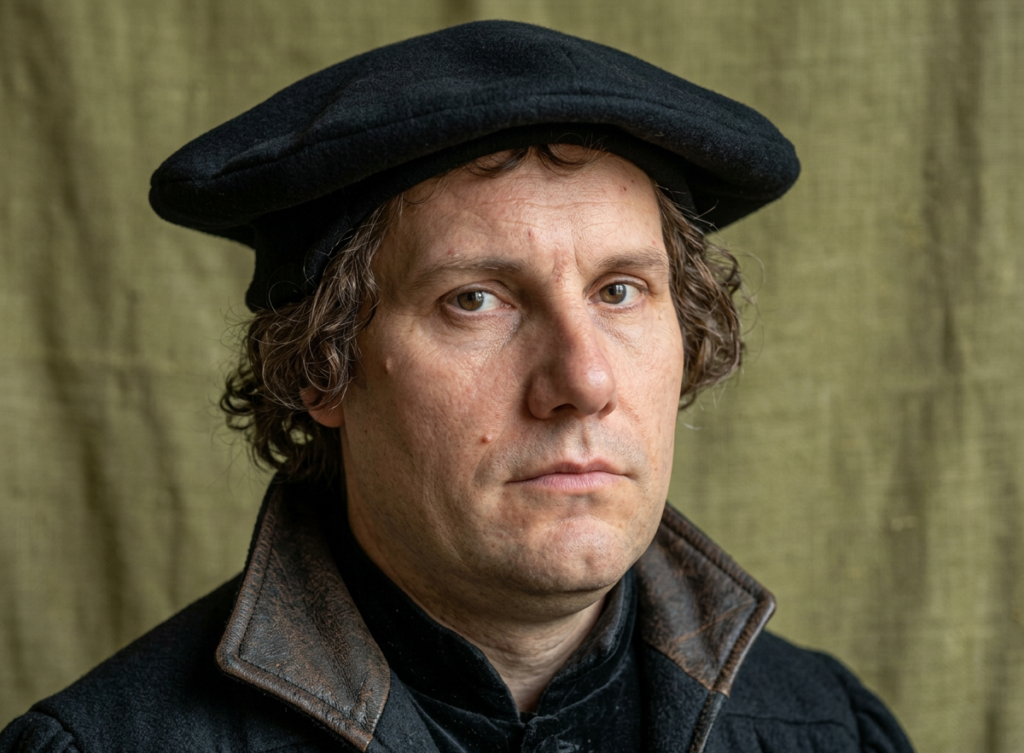
Martin Luther, a German theologian, is a central figure of the . His stand against the practices of the Catholic Church led to profound changes in the Christian religion and in European society.
LGH001
Martin LUTHER
Martin Luther, a central figure of the Protestant Reformation, criticized indulgences and other practices of the Catholic Church. He translated the Bible into German and published his 95 Theses in 1517, setting in motion a movement that transformed Christendom. His works profoundly influence European theology and society.
4 min
Protestant Reformation
Christian theology
95 Theses
Further information
You can consult:
Introduction
I. Youth and Education
1. Birth and Family Origins
o Martin Luther was born on November 10, 1483, in Eisleben, in the Holy Empire of the German Nation.
o He was the son of Hans Luder, a copper miner, and of Margarethe Luder.
2. Childhood and Education
o Luther grew up in Mansfeld, where he attended the Latin school.
o In 1501 he began his studies at the University of Erfurt, earning a bachelor's degree in 1502 and a master's degree in 1505.
3. Academic and Professional Training
o Originally destined for a career in law, he changed course after a spiritual experience during a storm, resolving to become an Augustinian monk in 1505.
o Luther was ordained a priest in 1507 and received a doctorate in theology in 1512 from the University of Wittenberg, where he went on to teach.
II. Early Career
1. First Steps in His Career
o Luther became a preacher and a professor at the University of Wittenberg.
o He quickly drew attention for his criticism of indulgences and other practices of the Catholic Church.
2. Early Accomplishments
o In 1517 he posted his 95 Theses on the door of the church in Wittenberg, denouncing the Church's abuses and calling for reform.
III. Height of His Career
1. Major Contributions and Accomplishments
o Luther translated the Bible into German, making the Scriptures accessible to a wider public.
o He wrote numerous theological works and pamphlets, profoundly influencing Christian theology and religious practice.
2. Influence and Legacy
o The , begun by Luther, led to the creation of new Christian denominations and to lasting changes in European religion and politics.
o His work encouraged literacy and influenced German culture and language.
IV. Personal Life
1. Family and Friendships
o In 1525 Luther married Katharina von Bora, a former nun. Together they had six children.
o He maintained close relationships with other reformers such as Philipp Melanchthon.
2. Interests and Passions
o Besides his theological work, Luther loved music and composed several hymns.
o He was also passionate about teaching and preaching.
V. Challenges and Controversies
1. Trials and Hardships
o Luther faced considerable opposition, including his excommunication by Pope Leo X in 1521.
o He was summoned to the Diet of Worms, where he refused to recant his writings.
2. Controversies and Criticism
o His writings against the peasants during the German Peasants' War and his views on the Jews have been widely criticized.
VI. End of Life and Death
1. Final Years
o Luther continued to teach and preach until his death, despite health problems.
o He suffered from various illnesses, including kidney stones and joint pain.
2. Death and Commemoration
o Martin Luther died on February 18, 1546, in Eisleben, his hometown.
o He is buried in the Castle Church in Wittenberg, and his legacy continues to be commemorated around the world.
Conclusion
Martin Luther had a significant impact on the religious and cultural history of Europe. Through his commitment and his writings, he set in motion reforms that transformed Christianity and influenced Western society. However, some of his writings remain controversial. It is important to analyze these positions in their political and historical context in order to better understand their implications.
“These men who have turned the world upside down have come here also”